
Industrial French Fries Production Market Entry Strategy for Bangladesh
Bangladesh’s frozen food market grows at 18% annually with french fries consumption reaching 12,000 tons through quick service restaurants and retail channels. Urban centers drive 85% of demand, creating immediate opportunities for local processing facilities that deliver consistent quality at import-competitive pricing levels.
- Market Demand: 12,000 tons annually
- Urban Consumption: 85% of total volume
- Growth Rate: 18% year-over-year
- Import Volume: 9,800 tons current
- Investment Threshold: $450,000 minimum
Dhaka-based QSR chains in Bangladesh currently import 90% of their french fries requirements, facing 28% import duties and cold chain losses exceeding 15%. Establishing local production eliminates these cost burdens while meeting BRCGS certification standards for institutional buyers across South Asia, creating export potential to neighboring markets.

Bangladesh Market Landscape for Frozen French Fries
The Bangladeshi frozen potato products market exhibits strong fundamentals driven by rapid urbanization and changing consumer preferences. Dhaka and Chittagong account for 65% of national consumption, with quick service restaurants expanding at 22% annually. International fast-food brands entering the market create immediate demand for locally produced, BRCGS-certified french fries that meet their global quality specifications while reducing landed costs by 32% compared to imports.
Current import dependency stands at 9,800 tons annually, primarily from Netherlands and Belgium, with shipments requiring 35-day transit times. This creates inventory challenges and quality degradation risks. Local production reduces lead times to 48 hours while maintaining optimal freshness. The retail segment, comprising modern trade supermarkets, shows 28% growth in frozen food categories, indicating expanding consumer acceptance beyond institutional buyers.
Investment Framework and Capacity Recommendations
Entry-level production facilities require $450,000 to $650,000 capital expenditure for semi-automated lines producing 300 to 500 kilograms per hour. This capacity serves Dhaka’s immediate QSR demand while maintaining 72% equipment utilization during initial market penetration phases. Operating costs average $0.42 per kilogram, including raw potatoes, utilities, and labor, delivering gross margins of 58% at wholesale pricing of $1.85 per kilogram.
Payback periods range from 3.2 to 4.1 years depending on capacity utilization and distribution efficiency. Facilities targeting 800 kilograms per hour capacity require $1.2 million investment but achieve payback in 2.8 years due to economies of scale and ability to supply institutional buyers nationwide. Currency hedging strategies are essential given Bangladesh’s taka volatility against the US dollar for equipment imports and spare parts procurement.
Local Supply Chain Integration Strategy
Bangladesh produces 8.5 million tons of potatoes annually, yet only 12% meet processing specifications for dry matter content above 20% and reducing sugar below 0.35%. Establishing contract farming networks in Bogra and Rangpur districts ensures consistent raw material supply. Processing facilities must implement receiving protocols including specific gravity testing and starch content analysis to maintain fry quality and color consistency.
Cold chain distribution represents the critical success factor, with refrigerated truck availability limited to major highways. Facilities should locate within 50 kilometers of Dhaka or Chittagong to minimize transport time to primary customers. Secondary cities require hub-and-spoke models using insulated containers. Compliance with Bangladesh Standards and Testing Institution (BSTI) regulations for frozen foods requires HACCP implementation and quarterly microbial testing.
Capacity Planning for Regional Market Capture
Facilities must align production capacity with geographic demand concentration. Dhaka metropolitan area consumes 4,200 tons annually, requiring minimum 500 kilograms per hour production to achieve market share above 15% within three years. Chittagong’s port city generates 2,100 tons of demand from tourism and export-oriented industrial zones, supporting a 300 kilograms per hour operation as viable entry strategy.
Seasonal demand fluctuations of 35% occur during Ramadan and wedding seasons, requiring frozen storage capacity for 150 tons of finished product to maintain continuous supply. Production scheduling should prioritize institutional contracts during peak periods while building retail inventory during off-peak months. Energy costs in Bangladesh average $0.12 per kilowatt-hour, making heat recovery systems essential for blanching and frying processes to maintain competitive cost structure.
Case Study: 500kg/hr Semi-Automated Line Configuration
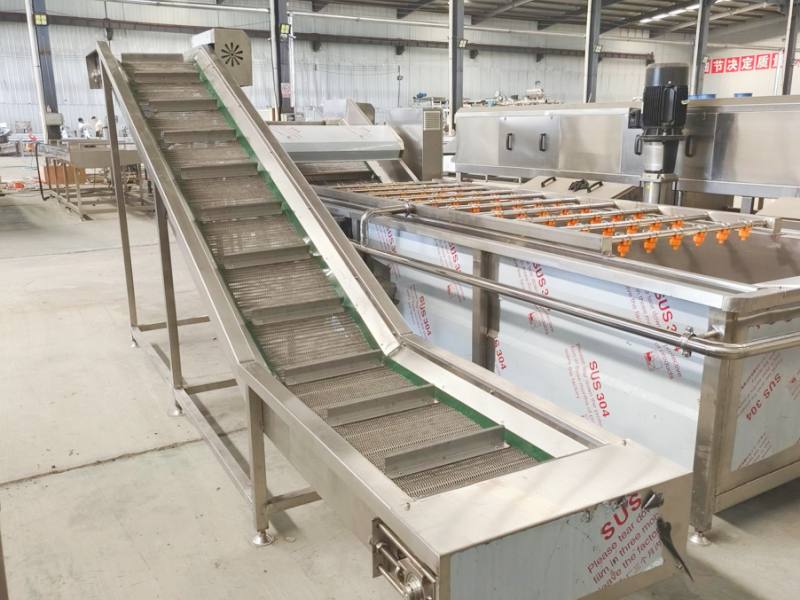
A recent feasibility study for a Dhaka-based investor demonstrates the 500 kilograms per hour configuration processing 3.5 tons of raw potatoes per shift. The line includes washing, steam peeling, cutting, blanching, drying, frying, freezing, and packaging modules. Power consumption totals 85 kilowatts per hour, with water usage at 2.8 cubic meters per shift. Labor requirements are 12 operators per shift across three production shifts.
Financial projections show $1.85 million annual revenue at 70% capacity utilization, with EBITDA margin of 41% after local tax considerations. The facility achieves break-even at 42% utilization, typically reached within 14 months of commissioning. Key success factors include securing advance purchase agreements with three major QSR chains and establishing direct potato contracts with 150 farmers in Rajshahi region to ensure raw material quality and cost stability.

Perguntas frequentes
What is the minimum viable capacity for Bangladesh market entry?
300 kilograms per hour represents the minimum viable capacity, generating $950,000 annual revenue at 65% utilization. This scale serves 2-3 major QSR clients while maintaining 55% gross margins. Smaller capacities face challenges covering fixed costs and quality certification expenses, which remain constant regardless of production volume.
How does currency fluctuation impact equipment procurement?
Bangladeshi taka volatility against the US dollar creates 8-12% price variation risk for imported machinery. We recommend forward contracts covering 70% of equipment value during project planning phase. Local assembly of non-critical components reduces foreign exchange exposure by 35%, while maintaining European standards for food contact surfaces and electrical controls.
What regulatory approvals are required for frozen french fries production?
Bangladesh requires BSTI product certification, Bangladesh Food Safety Authority license, and environmental clearance from Department of Environment. HACCP implementation is mandatory for institutional buyers. The approval timeline spans 4-6 months, during which equipment installation and trial production can proceed. BRCGS certification, while voluntary, opens export markets and commands 15% price premium from international QSR chains.