
Large Industrial French Fries Plant Above 1 Million Usd: Engineering Specifications for High-Capacity Processing
Large industrial French fries plants above 1 million USD typically process between 2,000 and 3,000 kilograms of raw potatoes per hour. These systems require steam pressure stabilization at 0.7 to 0.8 MPa for optimal thermal transfer during blanching and frying operations.
- Steam Pressure Tolerance: 0.7 to 0.8 MPa with PID control accuracy of plus or minus 0.02 MPa
- Peeling Waste Moisture: 85 percent moisture content post-abrasion to minimize starch loss
- Centrifugal Dewatering Force: G-factor above 400 G for surface moisture reduction below 3 percent
- Fryer Oil Level Precision: Plus or minus 2 mm automatic compensation via ultrasonic sensors
- IQF Belt Vibration: Frequency modulation between 25 and 35 Hz to prevent clumping
Since 1992, our Shandong facility has commissioned over 200 lines across 50 plus countries. These installations serve major markets in the Middle East, Africa, and Southeast Asia with continuous operation exceeding 22 hours daily.

Techno-Economic Snapshot
High-capacity French fries manufacturing requires precise correlation between throughput and utility consumption.
| Емкость | CapEx Range | Power Load | Water Demand | Footprint |
|---|---|---|---|---|
| 50 kg per hour | Below 200,000 USD | 45 kW | 1.5 cubic meters per hour | 200 square meters |
| 500 kg per hour | 400,000 to 600,000 USD | 120 kW | 4 cubic meters per hour | 800 square meters |
| 1,000 kg per hour | 700,000 to 900,000 USD | 220 kW | 8 cubic meters per hour | 1,200 square meters |
| 2,000 kg per hour | 1,200,000 to 1,500,000 USD | 380 kW | 15 cubic meters per hour | 2,000 square meters |
| 3,000 kg per hour | 1,800,000 to 2,200,000 USD | 550 kW | 22 cubic meters per hour | 2,800 square meters |
| 5,000 kg per hour | 3,000,000 to 3,500,000 USD | 850 kW | 35 cubic meters per hour | 4,500 square meters |
Core Process Engineering and Parameter Validation
Blanching Zone Temperature Profile and Starch Gelatinization
The first blanching zone operates at 75 degrees Celsius rather than 85 degrees Celsius to achieve optimal starch gelatinization without cellular collapse. At 75 degrees Celsius, the starch granules absorb water and swell uniformly, creating a gel matrix that prevents oil penetration during frying. This temperature preserves pectin structural integrity, maintaining strip rigidity through subsequent mechanical handling.
Higher temperatures at 85 degrees Celsius cause rapid outer layer gelatinization that seals moisture inside the potato strip. This sealing effect creates steam pressure during frying that ruptures cell walls, leading to excessive oil absorption above 10 percent. The 75 degrees Celsius setpoint allows gradual moisture egress while maintaining structural stability, reducing oil uptake to standardized 6 to 8 percent levels.
- Temperature Gradient: Zone 1 at 75 degrees C, Zone 2 at 85 degrees C for enzyme deactivation
- Residence Time: 4 to 6 minutes total across both zones for complete pectin methyl esterase inhibition
- SAPP Uptake: 1.0 percent solution concentration in second blancher for calcium chelation
- Steam Injection: Direct steam at 0.8 MPa for rapid heat transfer coefficient above 5,000 W per square meter Kelvin
- Water Circulation: Counter-current flow maintaining starch concentration below 2 percent to prevent deposition
Abrasive Peeling and Waste Stream Management
Abrasive peeling systems for large industrial French fries plants above 1 million USD utilize carborundum rollers operating at differential speeds to remove skin without excessive flesh loss. The peeling waste moisture content of 85 percent indicates efficient separation where water injection at 0.3 MPa carries removed skin fragments to cyclone separators. This moisture level confirms that starch-bearing flesh remains in the product stream rather than exiting with waste.
The engineering rationale for maintaining 85 percent moisture in waste relates to specific gravity separation efficiency. Dry peeling methods generate dust and lose up to 15 percent of edible flesh, whereas wet abrasion with precise water injection retains starch within the potato. The waste stream density of 1.05 grams per cubic centimeter allows cyclone separation at 15 meters per second air velocity, reducing biochemical oxygen demand in effluent treatment.
- Abrasive Roller Speed: Differential rotation at 120 to 150 RPM for uniform skin removal
- Water Injection Pressure: 0.3 MPa nozzles positioned at 45 degrees to waste chutes
- Peeling Loss Rate: Below 12 percent of raw material weight for oval tuber varieties
- Waste Moisture Verification: Inline near-infrared sensors calibrated to 85 percent plus or minus 3 percent
- Steam Peeling Alternative: High-pressure steam at 0.7 MPa for 20 seconds for thick-skinned varieties
Frying System Oil Management and Thermal Stability
Continuous fryers in high-capacity lines require oil turnover rates between 8 and 12 hours to maintain free fatty acid levels below 0.5 percent. This turnover rate represents the total oil volume divided by the hourly oil absorption rate, ensuring that degraded oil molecules exit the system before polymerization occurs. Fresh oil injection at the fryer entrance creates a counter-current flow that maximizes heat transfer efficiency while minimizing oxidation.
The fryer oil level precision of plus or minus 2 mm prevents thermal gradients that cause uneven frying rates. Ultrasonic level sensors communicate with variable frequency drives on makeup pumps to compensate for product loading variations. This precision maintains consistent residence time of 3 to 4 minutes at 175 to 185 degrees Celsius, ensuring moisture reduction from 75 percent to below 3 percent while developing Maillard reaction products for golden coloration.
- Oil Temperature Uniformity: Plus or minus 1.5 degrees Celsius across 4 meter width via multiple heating zones
- Heat Exchanger Surface: 50 square meters of stainless steel 316L with 0.7 MPa steam jackets
- Filtration Rate: Continuous removal of 100 percent volume every 30 minutes through 80 mesh screens
- Oil Level Control: Ultrasonic sensors maintaining plus or minus 2 mm with 0.1 second response time
- Free Fatty Acid Monitoring: Inline refractometers triggering oil replacement at 0.5 percent FFA
Capital Expenditure (CapEx) vs Operating Expenditure (OpEx) Analysis
The decision to invest in large industrial French fries plants above 1 million USD requires analysis of the trade-off between initial capital deployment and long-term operational efficiency. High-capacity lines achieve lower per-unit processing costs through economies of scale, yet require substantial infrastructure investment beyond the processing equipment itself.
Hidden Infrastructure Requirements
Projects in the 1 million to 2 million USD range necessitate supporting systems often excluded from initial quotations. These include boiler installations capable of generating 0.8 MPa steam at 2,000 kilograms per hour, chilled water systems for hydro-cooling, and compressed air stations for pneumatic controls.
| System Component | Specification | Cost Impact |
|---|---|---|
| Steam Boiler | 2,000 kg per hour at 0.8 MPa | 80,000 to 120,000 USD |
| Water Treatment | Reverse osmosis for 20 cubic meters per hour | 45,000 to 65,000 USD |
| Compressed Air | 500 liters per minute at 0.7 MPa | 15,000 to 25,000 USD |
| Electrical Transformer | 1,000 kVA capacity with switchgear | 35,000 to 50,000 USD |
| Spare Parts Kit | Critical components for 2 years operation | 60,000 to 90,000 USD |
| Process Piping | SUS304 stainless steel, 100 meters | 25,000 to 40,000 USD |
| Control Valves | Pneumatic actuated, 20 units | 18,000 to 28,000 USD |
| Effluent Treatment | Dissolved air flotation system | 55,000 to 75,000 USD |
| IQF Refrigeration | Ammonia compression system | 200,000 to 300,000 USD |
| Fire Suppression | Chemical extinguishing for fryer area | 20,000 to 30,000 USD |
Operating Expense Drivers
Operating costs for large industrial French fries plants above 1 million USD center on raw material yield, energy consumption, and oil degradation management. Understanding these drivers enables accurate EBITDA projections for investor presentations.
- Raw Potato to Finished Product Yield: Standard operations achieve 35 to 40 percent yield, while optimized lines with precision cutting and double-dewatering reach 42 to 45 percent, reducing raw material cost per kilogram by 8 to 12 percent.
- Oil Absorption Rates: Conventional frying systems absorb 8 percent oil by weight, whereas optimized low-pressure frying achieves 6 percent absorption, saving 20 kilograms of oil per ton of finished product.
- Electricity Consumption: High-efficiency motors and variable frequency drives reduce power draw to 0.18 kilowatt-hours per kilogram of product compared to standard 0.25 kilowatt-hours.
- Steam Efficiency: Insulated steam lines and heat recovery systems reduce steam consumption to 0.4 kilograms per kilogram of potatoes versus industry average 0.6 kilograms.
- Water Recycling: Counter-current washing and hydro-transport systems recycle 70 percent of process water, reducing municipal water costs and effluent charges.
- Maintenance Intervals: Predictive maintenance using vibration analysis extends bearing life to 20,000 hours, reducing spare parts consumption by 30 percent annually.
- Labor Efficiency: Automated sorting and packaging reduce labor requirements to 0.5 full-time equivalents per ton of hourly capacity, versus 2.0 in semi-automatic systems.
- Packaging Material: Exact weight control systems reduce giveaway from 5 percent to 1.5 percent, saving nitrogen-flushed bagging costs proportionally.
Payback Scenario and EBITDA Calculation
Financial modeling for large industrial French fries plants above 1 million USD assumes raw potato costs of 200 to 300 USD per ton and wholesale frozen fry prices of 800 to 1,200 USD per ton. At 2,000 kilograms per hour output operating 20 hours daily for 300 days annually, gross revenue reaches 48 million USD with EBITDA margins between 18 and 24 percent after full OpEx loading. The payback period typically ranges from 3.5 to 5 years depending on local utility costs and potato price volatility.
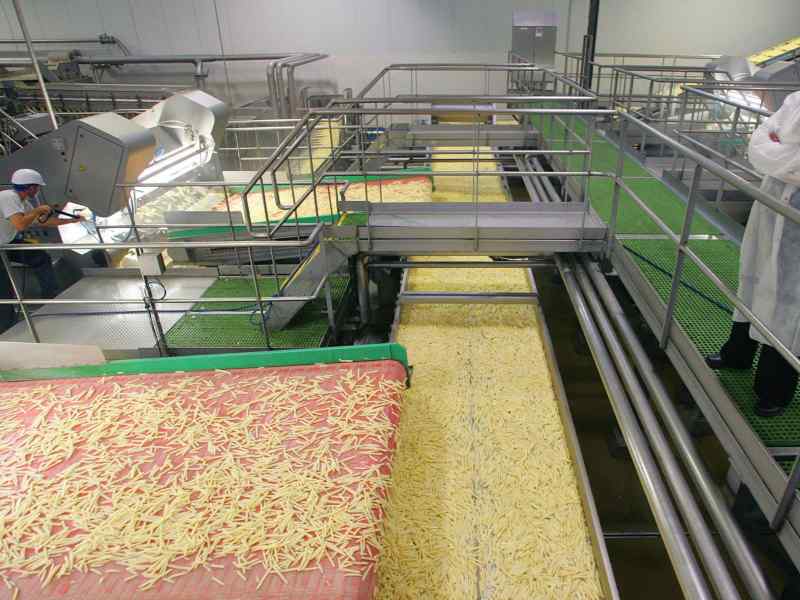
Project Report: 2,000 Kilogram Per Hour Line Commissioned in Egypt
A major agricultural processing group in Egypt commissioned a fully automated French fries line to supply domestic quick-service restaurants and retail chains.
- Customer: The client operates 5,000 hectares of potato cultivation in the Nile Delta region and sought vertical integration into frozen food production. With existing cold storage infrastructure of 10,000 pallet positions, the company required processing equipment capable of 2,000 kilograms per hour input to utilize harvest peaks during October through February.
- Challenge: Local water hardness exceeded 300 parts per million calcium carbonate, creating scaling risks in heat exchangers and blanchers. Additionally, 40-foot container shipping constraints from Shandong to Alexandria Port required modular equipment design with maximum single-piece weights below 8 tons for crane-offloading capabilities.
- Configuration:
- Steam peeling vessels with 0.7 MPa pressure ratings and 316L stainless steel construction
- Hydro-cutting systems with 22-kilowatt centrifugal pumps for 0.4 MPa water jet precision
- Double-drum dewatering centrifuges generating 450 G-force for surface moisture removal
- Outcome:
- Secured exclusive supply contract with national supermarket chain for 30 percent of production volume
- Achieved 30 percent yield increase over initial projections through precision peeling adjustment
- Key Lesson: The installation required installation of reverse osmosis pretreatment to reduce water hardness below 50 parts per million, preventing calcium deposits on heating surfaces. This modification added 45,000 USD to CapEx but reduced cleaning downtime from 4 hours weekly to 30 minutes, effectively increasing annual throughput by 8 percent.
Advanced Engineering Insights for Plant Optimization
Centrifugal Dewatering Physics and Par-Fry Quality
The dewatering centrifugal force measured in G-factor determines surface moisture removal efficiency before frying. Operating at 400 to 500 G for 30 seconds reduces surface moisture below 2 percent, preventing oil absorption spikes during initial frying contact. The specific gravity difference between potato strips at 1.08 grams per cubic centimeter and surface water creates separation force proportional to rotational speed squared.
Insufficient G-force below 300 G leaves residual moisture that flashes to steam upon oil contact, creating turbulence that increases oil turnover rate and reduces oil life. Excessive force above 600 G damages cell structure, creating fractures that absorb oil during frying. The optimal 450 G setting balances moisture removal with cellular integrity, reducing free fatty acid formation by limiting water ingress into the oil bath.
- Rotational Speed: 1,200 RPM on 400 millimeter diameter drums generates 450 G
- Residence Time: 25 to 35 seconds controlled by variable frequency drum drives
- Moisture Target: Below 2 percent surface moisture measured by capacitance sensors
- PT100 Integration: Temperature monitoring at drum inlet to adjust spin duration for warm versus cold strips
IQF Freezing Mechanics and Belt Dynamics
Individual Quick Freezing requires precise control of infeed throughput and belt vibration frequency to prevent clumping of par-fried strips. The IQF belt vibration frequency of 25 to 35 Hz creates fluidization that separates strips while maintaining product orientation for blast air penetration. This frequency range coincides with the natural resonance of potato tissue at minus 25 degrees Celsius, maximizing heat transfer without mechanical damage.
Residence time in the IQF tunnel correlates with strip thickness and reducing sugar content, which affects freezing point depression. Strips with 0.3 percent reducing sugars require 12 minutes at minus 35 degrees Celsius air temperature, while high-sugar content above 1.0 percent requires 15 minutes to prevent enzymatic browning during storage. The belt vibration prevents ice bridges from forming between strips, ensuring individual piece integrity for retail packaging.
- Fluidization Air Velocity: 4 to 6 meters per second through perforated belt
- Vibration Amplitude: 2 to 3 millimeters peak-to-peak displacement
- Evaporator Temperature: Minus 40 degrees Celsius with 4-row coil configuration
- Final Product Temperature: Minus 18 degrees Celsius core temperature verified by needle probes
Process Control Architecture and Sensor Integration
Modern large industrial French fries plants above 1 million USD utilize distributed control systems with PT100 sensors positioned at critical control points including blancher discharge and fryer inlet. These platinum resistance temperature detectors provide accuracy of plus or minus 0.1 degrees Celsius, enabling PID control loops that maintain process parameters within specification. The reducing sugar content of raw potatoes, measured by specific gravity and colorimetric testing, determines frying temperature setpoints to prevent excessive browning.
Specific gravity sorting upstream separates high-solid potatoes above 1.08 specific gravity for premium fry production, while lower density tubers route to secondary processing. This segregation optimizes frying time and oil absorption rates across product grades. The integration of near-infrared spectroscopy for oil quality monitoring and vision systems for defect removal creates closed-loop quality control that reduces manual inspection labor by 80 percent.
- PT100 Calibration: Annual verification against ice point and steam point standards
- Specific Gravity Separation: Hydrolift tanks with brine density at 1.06 grams per cubic centimeter
- Reducing Sugar Testing: Automated sampling every 2 hours with enzymatic assay correlation
- Control Loop Response: PID algorithms with 0.5 second scan rates for temperature stability

International Food Safety and Engineering Standards
- HACCP: Our lines incorporate critical control points at blanching temperature, frying oil quality, and metal detection with automatic rejection systems to prevent biological and physical hazards.
- ISO 22000: Complete documentation of prerequisite programs including equipment sanitation protocols and allergen management procedures traceable through batch records.
- BRCGS Issue 9: Construction utilizes food-grade SUS304 stainless steel with full weld penetration and radiused corners to eliminate harborage points for bacterial growth.
- IFS Food: Validation of cleaning in place systems with turbulent flow rates above 1.5 meters per second to ensure sanitation chemical contact with all product contact surfaces.
- FDA 21 CFR 117: Compliance with Current Good Manufacturing Practice requirements for plant layout design that separates raw and cooked product zones to prevent cross-contamination.
- EU Regulation 2017/2158: Acrylamide mitigation through controlled frying temperatures below 175 degrees Celsius when reducing sugar content exceeds 0.3 percent in incoming potatoes.
Часто задаваемые вопросы
What is the minimum steam boiler capacity required for a 2,000 kilogram per hour French fries line?
A 2,000 kilogram per hour line requires steam generation of 1,500 to 2,000 kilograms per hour at 0.7 to 0.8 MPa pressure. This capacity serves the blanching system, frying heat exchangers, and peeling operations simultaneously. The boiler should maintain pressure stability within plus or minus 0.02 MPa to prevent temperature fluctuations that affect product quality.
How does the dewatering centrifuge G-factor affect final product oil content?
Operating the dewatering centrifuge at 400 to 450 G reduces surface moisture to below 3 percent before frying, which limits oil absorption to 6 to 8 percent. Lower G-forces below 300 G leave excess moisture that causes violent boiling in the fryer, increasing oil uptake to 10 percent or higher. The centrifugal force must balance moisture removal against cellular damage that creates oil pockets in the finished product.
What are the key differences between steam peeling and abrasive peeling for high-capacity lines?
Steam peeling at 0.7 MPa for 15 to 20 seconds removes skin through pressure differential expansion, generating waste moisture of 75 to 80 percent with minimal flesh loss. Abrasive peeling produces 85 percent moisture waste but handles irregular tuber shapes better. Steam systems require higher capital investment but reduce water treatment costs by 30 percent compared to abrasive methods for large industrial French fries plants above 1 million USD.