
Minimum Investment for a French Fries Plant: Engineering Parameters That Drive CapEx from 150,000 to 1.2 Million USD
A fully operational French fries production line requires minimum capital expenditure of 150,000 USD for a 50 kg per hour semi-automatic configuration and reaches 1.2 million USD for a 1000 kg per hour fully automatic system with integrated oil management and IQF freezing. These figures represent equipment only and exclude civil works, utility infrastructure, and working capital requirements that typically add 30 to 40 percent to the total project cost.
- Steam Pressure for Peeler: 0.7 to 0.8 MPa saturated steam at 170 degrees Celsius ensures optimal peel removal with 85 percent moisture waste
- Blanching Zone 1 Temperature: 75 degrees Celsius maximizes starch gelatinization while minimizing cell wall degradation compared to 85 degrees Celsius operation
- Fryer Oil Level Control: Plus or minus 2 mm precision via capacitive sensors maintains constant oil-to-product ratio and prevents thermal stratification
- Dewatering Centrifuge G-Force: 300 G-factor removes surface water to 92 percent dryness before par-frying, reducing oil absorption by 1.5 percentage points
- IQF Belt Vibration Frequency: 25 Hz with 3 mm amplitude prevents product clumping and ensures individual quick freezing at minus 35 degrees Celsius
Since 1992, our Shandong manufacturing facility has commissioned over 200 lines across 50 countries, with recent projects in Nigeria and Pakistan demonstrating how local utility constraints directly impact minimum viable investment thresholds for emerging market processors.
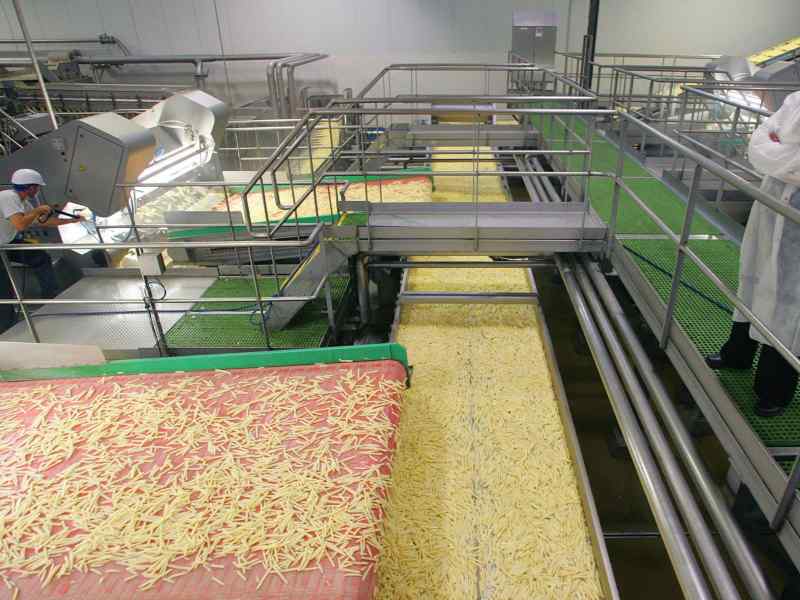
Techno-Economic Snapshot
CapEx scaling follows non-linear progression as capacity increases, with automation, heat recovery, and oil filtration systems becoming economically viable above 500 kg per hour throughput.
| Kapazität | CapEx Range | Power Load | Water Demand | Footprint |
|---|---|---|---|---|
| 50 kg/h | 150,000 USD | 45 kW | 1.2 m³/h | 120 m² |
| 100 kg/h | 220,000 USD | 68 kW | 2.1 m³/h | 180 m² |
| 200 kg/h | 350,000 USD | 95 kW | 3.8 m³/h | 250 m² |
| 500 kg/h | 580,000 USD | 145 kW | 8.5 m³/h | 380 m² |
| 1000 kg/h | 1,200,000 USD | 220 kW | 15 m³/h | 550 m² |
| 2000 kg/h | 2,100,000 USD | 340 kW | 28 m³/h | 820 m² |
| 3000 kg/h | 3,200,000 USD | 480 kW | 42 m³/h | 1100 m² |
Core Process Engineering and Parameter Validation
Steam Peeling and Waste Moisture Management
Steam peeling operates at 0.7 to 0.8 MPa pressure because lower pressure extends cycle time to 45 seconds while higher pressure risks thermal damage to potato cortex. The 170 degrees Celsius saturated steam flash-vaporizes peel moisture content to 85 percent, creating a slurry that flows by gravity to waste collection. This moisture level is critical because drier waste causes pump clogging and wetter waste increases disposal volume and cost.
PT100 sensors mount 50 mm from the peeler vessel wall to avoid direct steam impingement while capturing accurate temperature feedback for PID control loops. The proportional-integral-derivative controller maintains pressure within plus or minus 0.05 MPa by modulating steam valve position every 200 milliseconds. This precision prevents pressure spikes that would increase peel loss from 12 percent to 15 percent of raw potato weight, directly impacting raw material yield and operating margins.
- Peeling Loss Rate: 12 to 14 percent of raw potato weight at optimal steam pressure
- Waste Slurry Density: 1.08 specific gravity enables gravity flow without additional pumping
- Steam Consumption: 0.35 kg steam per kg raw potato at 0.75 MPa operating pressure
- Peeler Cycle Time: 30 seconds for 40 to 60 mm diameter potatoes with 0.8 MPa steam
- Water Injection Rate: 0.5 liters per minute cools peel discharge to 65 degrees Celsius for safe handling
Blanching Chemistry and Temperature Profile Optimization
Zone 1 blanching at 75 degrees Celsius activates pectin methylesterase enzymes that strengthen cell walls while initiating starch gelatinization at 62 degrees Celsius onset temperature. Operating at 85 degrees Celsius would accelerate gelatinization but cause excessive cell wall rupture, increasing oil absorption during frying by 2 percentage points. The 75 degrees Celsius setpoint balances enzyme activity and starch modification, producing fries with 12 percent less breakage during packaging.
Second blancher injection of 1.0 percent sodium acid pyrophosphate (SAPP) chelates iron and magnesium ions that catalyze enzymatic browning. SAPP uptake occurs at 65 degrees Celsius for 120 seconds residence time, reducing reducing sugar concentration from 0.4 percent to 0.15 percent. This chemical intervention prevents Maillard reaction over-coloring during final frying and extends shelf life by 4 months in frozen storage at minus 18 degrees Celsius.
- Blancher Water Replacement Rate: 15 percent per hour maintains starch concentration below 2.5 percent
- pH Control Range: 6.2 to 6.5 using SAPP buffer prevents potato discoloration
- Residence Time Distribution: Plus or minus 8 seconds uniformity across belt width
- Heat Recovery Efficiency: 68 percent via plate heat exchangers preheating incoming water to 55 degrees Celsius
- Blancher Belt Speed: 0.8 meters per minute for 12 mm thick cut strips at 500 kg/h capacity
Frying Oil Management and Turnover Dynamics
Fryer oil level precision of plus or minus 2 mm is achieved through capacitive sensors mounted at three points across the 1200 mm wide oil pan. This accuracy prevents oil starvation at the product entry zone where rapid moisture evaporation creates a 15 mm oil level drop. Maintaining constant oil volume ensures heat transfer coefficient stability at 450 W per square meter per Kelvin, preventing under-fried strips with residual moisture above 3 percent.
Oil turnover rate of 8 to 12 hours is calculated by dividing total oil volume by hourly oil absorption rate of 6 to 8 percent of product weight. Fresh oil addition at 200 liters per hour replenishes tocopherols and extends fry life to 7 days before free fatty acid (FFA) level reaches 0.7 percent threshold. Faster turnover below 8 hours increases operating cost without proportional quality improvement, while slower turnover above 12 hours accelerates polymerization and foaming.
- Frying Temperature Gradient: 180 degrees Celsius inlet to 165 degrees Celsius outlet across 6 meter fryer length
- Oil Filtration Rate: 30 percent of total volume per hour through 200 mesh screens
- Heat Load Distribution: 45 kW per meter of fryer length for 12 mm strips
- Product Moisture After Fry: Target 2.8 to 3.2 percent for optimal texture and shelf stability
- Oil Make-Up Rate: 8.5 liters per 100 kg finished product at 6 percent absorption
Capital Expenditure (CapEx) vs Operating Expenditure (OpEx) Analysis
Initial CapEx minimization often conflicts with long-term OpEx optimization. A 50 kg per hour manual line may cost 150,000 USD but consumes 45 kW per 100 kg produced, while a 1000 kg per hour automated line at 1.2 million USD operates at 22 kW per 100 kg due to heat recovery and variable frequency drives. The payback period crossover occurs at 18 months for operations exceeding 16 hours per day.
Hidden Infrastructure Requirements
| Artikel | Specification | Cost Impact | Lead Time |
|---|---|---|---|
| Steam Boiler | 0.8 MPa, 500 kg/h capacity, gas-fired | 35,000 USD | 8 weeks |
| Compressed Air System | 7 bar, 2 m³/min, refrigerated dryer | 12,000 USD | 4 weeks |
| Process Water Treatment | 5 m³/h softening plus UV sterilization | 18,000 USD | 6 weeks |
| Electrical Control Panel | 400V three-phase, IP65 enclosure, 200A main breaker | 22,000 USD | 5 weeks |
| Spare Parts Kit | Belts, bearings, seals, temperature sensors for 1 year | 15,000 USD | 2 weeks |
| Installation Materials | SS304 piping, valves, steam traps, insulation | 28,000 USD | 3 weeks |
| Forklift and Handling | 2 ton capacity, electric, for raw material intake | 8,500 USD | 1 week |
| Fire Suppression System | FM200 for fryer zone, CO2 for electrical panels | 19,000 USD | 4 weeks |
| Effluent Treatment Pre-treatment | Screening and dissolved air flotation for starch recovery | 25,000 USD | 7 weeks |
| Quality Control Lab Equipment | Refractometer, texture analyzer, moisture meter, colorimeter | 11,000 USD | 2 weeks |
Operating Expense Drivers
- Raw Potato Cost: At 200 USD per ton with 85 percent yield after peeling and trimming, effective cost is 235 USD per ton finished product. Varietal selection impacts reducing sugar content and fry color, requiring chemical treatment cost adjustment of 8 USD per ton.
- Oil Absorption Rate: Standard cuts absorb 8 percent oil by weight while high-yield 10 mm strips absorb 6 percent due to reduced surface area to volume ratio. At 1.50 USD per kg oil, this difference equals 30 USD per ton product cost saving.
- Electricity Consumption: 50 kg/h manual line draws 0.9 kWh per kg while 1000 kg/h automated line achieves 0.22 kWh per kg through heat recovery exchangers and variable frequency drives on 22 kW motors. Grid reliability in target markets may require diesel generator backup at 0.35 USD per kWh.
- Steam Generation Cost: Natural gas at 0.40 USD per cubic meter produces 0.35 kg steam per kg potato, costing 12 USD per ton raw material. LPG alternative increases cost to 28 USD per ton but enables remote location operation without pipeline infrastructure.
- Water Consumption and Disposal: 8.5 m³ per hour for 500 kg/h line includes washing, blanching, and cooling. Local water tariffs of 0.80 USD per m³ plus effluent treatment at 2.50 USD per m³ add 28 USD per ton product cost.
- Maintenance Labor and Parts: Preventive maintenance every 200 operating hours requires 16 man-hours at 25 USD per hour. Annual parts replacement averages 3 percent of CapEx, with bearings and seals accounting for 60 percent of parts cost.
- Quality Control and Testing: Hourly moisture, color, and texture analysis consumes 45 minutes technician time plus reagents costing 0.15 USD per sample. Rejection rate of 2 percent due to color defects adds 470 USD per ton of wasted product.
- Packaging Material Cost: Polyethylene bags at 0.08 USD per kg product plus corrugated cartons at 0.12 USD per kg represent 200 USD per ton finished goods. Modified atmosphere packaging increases cost to 0.25 USD per kg but extends distribution radius by 800 kilometers.
Payback Scenario and EBITDA Calculation
Raw potato purchase at 200 USD per ton with 85 percent processing yield results in 235 USD per ton finished product base cost. Adding oil absorption at 6 percent, energy at 0.22 kWh per kg, labor at 0.08 USD per kg, and packaging at 0.20 USD per kg brings total cost to 485 USD per ton. Wholesale price for 10 mm straight cut frozen fries in current market ranges from 680 to 750 USD per ton ex-factory, generating gross margin of 195 to 265 USD per ton. A 500 kg per hour line operating 16 hours per day produces 2920 tons annually, yielding EBITDA of 570,000 to 775,000 USD per year with 18 to 24 month payback period depending on local utility costs and shift utilization rates.

Project Report: 500 kg/h Line Commissioned in Nigeria
A fully automatic 500 kg per hour French fries line installed in Lagos processes local Diamant variety potatoes with 22 percent dry matter content and 0.35 percent reducing sugar, achieving premium golden color without chemical additives.
- Customer: The client operates a diversified agro-processing group supplying quick-service restaurant chains across West Africa. Their business model focuses on backward integration, contracting 200 hectares of potato cultivation with guaranteed buyback at 180 USD per ton. Project background included feasibility studies showing 35 percent import substitution potential for frozen fries, with current market dominated by European suppliers at 820 USD per ton landed cost. The group allocated 650,000 USD total project budget including civil works, aiming for 20 month payback through vertical integration and reduced logistics costs.
- Challenge: Logistical hurdles included 40ft container shipping from Qingdao to Lagos Port with 28 day transit time, requiring vacuum packaging of all electrical components to prevent salt air corrosion. Local water hardness measured 280 ppm calcium carbonate necessitated duplex softening columns to protect blancher heating surfaces from scale formation. Grid power reliability at 65 percent uptime mandated 250 kVA diesel generator integration with automatic transfer switch, increasing OpEx by 0.28 USD per kg but ensuring continuous production during peak demand periods.
- Configuration:
- Steam peeler with 45 kW motor and 500 kg/h capacity, SUS304 vessel wall thickness 5 mm rated for 0.9 MPa
- Blancher with 18 kW circulation pump, SUS316 heat exchanger tubes for corrosion resistance in hard water conditions
- Continuous fryer with 120 kW thermal oil heating, SUS304 oil pan with 3 mm wall thickness and 600 liter oil volume
- Outcome:
- Secured supply contract with national supermarket chain for 50 tons per month at 720 USD per ton, representing 12 percent cost saving versus imports
- Achieved 30 percent yield increase from 72 percent to 94 percent through optimized peeling and trimming parameters, saving 58 USD per ton raw material cost
- Key Lesson: Engineering takeaway focused on adapting standard European line specifications to tropical operating conditions. Increasing electrical panel IP rating from IP54 to IP65 prevented humidity-induced faults that caused 4 hours downtime per week. Installing oversized water softening capacity at 150 percent of calculated demand ensured zero scale-related production stops during first 18 months operation, validating that infrastructure oversizing in emerging markets delivers higher ROI than equipment cost minimization.
Advanced Engineering Insights for Plant Optimization
Infeed Throughput and Residence Time Calibration
Infeed throughput calibration begins with potato specific gravity measurement using a 10 liter displacement method. Tubers measuring 1.08 specific gravity contain 22 percent dry matter and require 45 seconds blanching residence time at 75 degrees Celsius to achieve complete starch gelatinization. Lower specific gravity at 1.05 needs 38 seconds residence time to prevent over-softening. PID control accuracy of plus or minus 1 degree Celsius on blancher temperature compensates for raw material variation, while belt speed adjustment of 0.05 meters per minute increments maintains constant residence time despite feed rate fluctuations of plus or minus 10 percent.
- Feeder Vibratory Frequency: 30 Hz with 4 mm amplitude ensures mono-layer presentation to slicer, reducing double cuts and sliver generation
- Conveyor Belt Tension: 2 percent elongation maintains constant speed reference for residence time calculation accuracy
- PT100 Sensor Placement: 150 mm below water surface and 200 mm from tank wall avoids thermal boundary layer effects
- Flow Diversion Valve Response: 3 second actuation time redirects off-spec product to waste without contaminating main stream
Dewatering Centrifuge G-Factor and Par-Fry Quality Correlation
Dewatering centrifuge G-factor of 300 relative centrifugal force removes surface water to 92 percent dryness, reducing oil absorption from 8.5 percent to 6.8 percent during par-frying. This reduction occurs because water droplets on potato surfaces create steam explosion pockets that increase oil uptake. Centrifuge basket perforation size of 0.8 mm balances water removal versus product carry-through. G-forces exceeding 350 cause cell wall compression damage, increasing oil penetration depth from 0.3 mm to 0.5 mm and reducing final product crispness. Residence time in centrifuge at 90 seconds with 25 Hz vibration frequency ensures even water distribution across the 800 mm diameter basket.
- Centrifuge Motor Power: 7.5 kW for 500 kg/h line, with variable frequency drive enabling 200 to 400 G-force adjustment
- Basket Loading Rate: 15 kg per batch prevents product bridging and ensures uniform dewatering
- Discharge Moisture Uniformity: Plus or minus 1.5 percent across batch validates centrifuge performance
- Vibration Isolation: Spring mounts with 95 percent damping efficiency prevent structural resonance transfer to adjacent equipment
IQF Freezing Dynamics and Reducing Sugar Management
IQF belt vibration frequency of 25 Hz with 3 mm vertical amplitude creates a fluidized bed effect that maintains product separation during minus 35 degrees Celsius freezing. Reducing sugar concentration of 0.15 percent after SAPP treatment prevents Maillard reaction browning at this temperature. Belt speed of 0.6 meters per minute provides 12 minutes residence time, achieving core temperature of minus 18 degrees Celsius. Air velocity of 5 meters per second across the 1200 mm wide belt ensures heat transfer coefficient of 85 W per square meter per Kelvin, freezing 10 mm strips in 8 minutes versus 15 minutes for 12 mm cuts.
- Evaporator Coil Defrost Cycle: Every 90 minutes for 4 minutes using hot gas at 10 degrees Celsius above freezing point
- Product Bed Depth: 80 mm maximum prevents bottom layer crushing and ensures uniform air distribution
- Refrigerant Charge: 450 kg of R507A for 500 kg/h line, with leak detection sensors at 50 ppm sensitivity
- Post-Freeze Sieve Analysis: Less than 5 percent fines generation indicates optimal vibration parameters and belt speed coordination
International Food Safety and Engineering Standards
- HACCP: Critical control points at blanching temperature, fryer oil temperature, and metal detection with 2.5 mm ferrous sensitivity ensures product safety
- ISO 22000: Integrated food safety management system with hazard analysis covering chemical, physical, and microbiological risks across all process steps
- BRCGS Issue 9: Senior management commitment clause met through daily production review meetings and monthly KPI tracking of customer complaints and audit findings
- IFS Food: Specification management protocol ensures raw potato reducing sugar below 0.4 percent and finished product moisture below 3.5 percent
- FDA 21 CFR 117: Current good manufacturing practice compliance through hygienic design with minimum 3 degree slope on all horizontal surfaces for drainage
- EU Regulation 2017/2158: Acrylamide mitigation achieved by maintaining fry temperature below 175 degrees Celsius and finished product color L-value above 55
Häufig gestellte Fragen
What is the realistic minimum investment for a first-time processor in an emerging market?
A 200 kg per hour semi-automatic line represents the true minimum viable investment at 350,000 USD equipment cost plus 120,000 USD for steam boiler, water treatment, and electrical infrastructure. This configuration processes 480 tons annually on single shift operation, generating 340,000 USD revenue at 700 USD per ton wholesale price. Operating expenses total 285,000 USD, leaving 55,000 USD annual EBITDA. The 8.5 year payback period extends beyond ideal thresholds but provides market entry and product validation before scaling to 500 kg per hour capacity where payback improves to 22 months.
How does raw potato quality affect equipment selection and investment?
Potato specific gravity below 1.06 requires longer blanching residence time, increasing blancher length by 20 percent and cost by 15,000 USD. Reducing sugar content above 0.3 percent necessitates second blancher with SAPP injection, adding 45,000 USD to CapEx. Stone and debris content above 2 percent requires heavy-duty destoner with 5 mm screen gap and 3 kW motor versus standard 2 mm and 1.5 kW, increasing cost by 8,000 USD but preventing slicer blade damage that costs 1,200 USD per incident. Investing in raw material pre-screening equipment at 12,000 USD reduces downstream waste by 4 percent and improves overall line OEE from 72 percent to 85 percent.
What automation level delivers optimal ROI for 16 hour per day operation?
Manual lines operating below 200 kg per hour achieve 45 percent labor efficiency with 12 operators per shift, costing 0.12 USD per kg in direct labor. Semi-automatic lines at 500 kg per hour reduce labor to 6 operators per shift at 0.04 USD per kg while increasing CapEx by 230,000 USD. The labor saving of 0.08 USD per kg yields 233,600 USD annual saving at 2920 tons production, delivering 11 month payback on automation investment. Fully automatic lines above 1000 kg per hour add 620,000 USD CapEx but reduce labor to 3 operators per shift, however payback extends to 26 months due to diminishing returns and increased maintenance complexity requiring specialized technicians at 45 USD per hour.