
IQF Freezing Time Engineering Parameters for Industrial French Fry Production
Industrial IQF freezing time for french fries typically ranges from 8 to 15 minutes depending on cut size, initial temperature, and freezer capacity. This parameter directly impacts product texture, moisture retention, and production throughput in continuous processing environments. Understanding the engineering fundamentals enables precise equipment selection and process optimization for high-volume operations.
- Processing Capacity: 2-5 tons per hour per freezing tunnel module
- Energy Consumption: 85-120 kWh per metric ton of finished product
- Product Yield: 98.5% retention rate with optimized airflow design
- Residence Time: 12-18 minutes total belt transit for complete crust freezing
- Evaporator Temperature: -35°C to -40°C for rapid heat transfer
Global frozen potato processing facilities operate under strict technical specifications where freezing time determines final product quality and equipment sizing for continuous production lines. Precise control of this parameter ensures compliance with international frozen food standards while maximizing production efficiency.

Thermodynamic Principles of IQF Freezing Time
IQF freezing time represents the duration required to reduce french fry core temperature from blanching temperature to -18°C storage temperature. This process involves complex heat transfer mechanisms including conduction, convection, and latent heat removal during phase change from water to ice.
Critical Temperature Zones
The freezing curve for potato products exhibits three distinct phases. Initial cooling from 70°C to 0°C removes sensible heat. The plateau phase at 0°C involves latent heat extraction where 80% of total freezing time occurs. Final subcooling from 0°C to -18°C completes the process.
Heat Transfer Coefficient Optimization
Air velocity within the freezing tunnel directly impacts the convective heat transfer coefficient. Industrial systems operate at 4-6 m/s airflow velocity to achieve 50-70 W/m²K heat transfer coefficients. Higher velocities reduce freezing time but increase product dehydration risk and energy consumption.
Product Geometry Impact
Cut dimensions fundamentally alter freezing time calculations. Standard 7mm x 7mm cross-section fries require 8-10 minutes. Thicker 10mm steak fries need 12-15 minutes. Surface-area-to-volume ratios determine heat transfer efficiency and must be factored into belt speed calculations.
Equipment Design Criteria for Precise Freezing Time Control
Modern IQF freezers employ modular design principles allowing capacity expansion through tunnel lengthening or parallel installation. Belt width typically ranges from 1200mm to 2600mm with single-tier or multi-tier configurations affecting total freezing capacity.
Conveyor Belt System Engineering
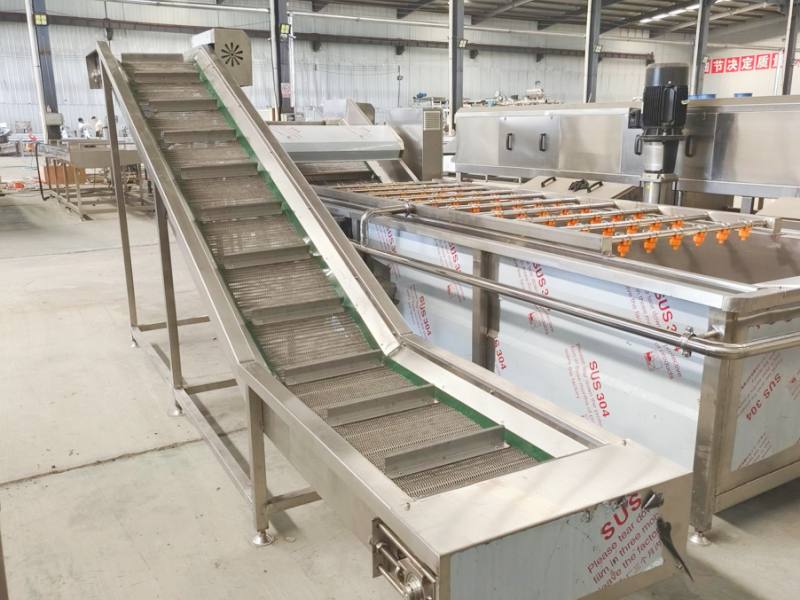
Stainless steel mesh belts with 2mm x 4mm openings provide optimal product support while allowing vertical airflow penetration. Belt speed adjustment from 0.5 to 3.0 meters per minute enables precise residence time control. Tensioning systems maintain belt flatness within ±2mm tolerance.
Evaporator Coil Configuration
Fin spacing of 10-12mm prevents frost bridging while maximizing heat exchange surface area. Coil block design incorporates 6-8 rows deep with face areas calculated based on product loading density of 30-40 kg/m². Defrost cycles occur every 6-8 hours using hot gas or water methods.
Airflow Management Systems
Centrifugal fans with variable frequency drives deliver 30,000-80,000 m³/h airflow per tunnel section. Plenum design ensures ±5% velocity uniformity across belt width. Air temperature stratification remains below 2°C from inlet to outlet zones.
Automation and Real-Time Process Monitoring
Advanced PLC systems continuously monitor and adjust freezing parameters to maintain consistent product quality. Temperature sensors positioned at multiple points track air temperature, product surface temperature, and core temperature progression.
Sensor Integration Protocols
Infrared thermal cameras monitor product surface temperature distribution across belt width. Thermocouple probes sample product core temperature every 30 seconds. Pressure differential sensors detect frost buildup on evaporator coils triggering automated defrost sequences.
Data Acquisition Systems
SCADA platforms log freezing time data for each production batch with 1-second resolution. Historical trending analysis identifies performance degradation requiring maintenance intervention. Integration with MES systems enables traceability from raw potato to frozen package.
Product Quality Correlation with Freezing Time
Optimal freezing time prevents ice crystal formation that damages cell structure. Rapid freezing creates small intracellular ice crystals preserving texture and reducing moisture loss during reheating. Extended freezing times produce large extracellular crystals causing spongy texture and increased oil absorption.
Moisture Migration Control
Proper freezing time minimizes surface dehydration preventing freezer burn. Product moisture loss should remain below 2% by weight. Air humidity control at 85-90% RH in pre-cooling zones reduces evaporative losses before crust freezing occurs.
Texture Preservation Mechanics
Potato starch gelatinization during blanching creates a protective layer. Rapid freezing locks this structure preventing retrogradation. Freezing time exceeding 20 minutes allows amylose recrystallization resulting in mealy texture after final cooking.
International Technical Standards Compliance
Industrial IQF freezing systems must meet stringent regulatory requirements for frozen food processing. Equipment design and operating parameters follow codified standards ensuring product safety and quality consistency across global markets.
USDA and FDA Requirements
Freezing time must achieve core temperature of -18°C within maximum 30 minutes for microbial control. Equipment surfaces must use food-grade 304 or 316 stainless steel. Clean-in-place systems operate at 75°C with 2% caustic solution for sanitization.
European Frozen Food Directive
EU regulations mandate continuous temperature monitoring with alarm systems for deviations exceeding 2°C. Freezing tunnels require HACCP certification with critical control points at freezing time validation and temperature maintenance. Equipment must carry CE marking with machinery directive compliance.
Industrial Performance Benchmarking
Comparative analysis of IQF freezer performance across different capacity ranges reveals consistent engineering relationships between freezing time and operational parameters. These benchmarks guide equipment selection for new facility design.
| Cut Size (mm) | Capacity (t/h) | Freezing Time (min) | Energy Use (kWh/t) | Air Velocity (m/s) |
|---|---|---|---|---|
| 7×7 | 2.5 | 8-10 | 85 | 4.5 |
| 7×7 | 4.0 | 10-12 | 95 | 5.2 |
| 10×10 | 3.0 | 12-14 | 105 | 5.0 |
| 13×13 | 2.5 | 14-16 | 115 | 4.8 |
Data represents operational parameters from installations in North America, Europe, and Asia with ambient conditions of 25°C and 60% relative humidity. Actual performance varies based on potato variety, blanching temperature, and pre-cooling efficiency.
Technical Implementation Parameters from Commissioned Systems
A recent installation in Eastern Europe processing Bintje potatoes required 3.5 tons per hour capacity for 9mm straight cut fries. Engineering calculations determined a 14-meter tunnel length with 1200mm belt width achieving 11-minute freezing time at -38°C evaporator temperature.
The system incorporates dual-stage cooling with ammonia refrigerant and glycol secondary loop. Belt speed set at 1.27 meters per minute provides precise residence time control. Airflow distribution achieves ±3% velocity uniformity through computational fluid dynamics optimization.
Performance validation using embedded thermocouters confirmed core temperature reached -18°C within 10.5 minutes average. Product moisture loss measured at 1.8% met specification requirements. The installation demonstrates how theoretical freezing time calculations translate to operational reality.

Engineering FAQ on IQF Freezing Time
How does product loading density affect freezing time calculations?
Loading density directly impacts heat load per square meter of belt area. Standard calculations assume 35 kg/m² product loading. Increasing density to 45 kg/m² extends freezing time by 15-20% due to reduced airflow penetration between product pieces. Engineers must balance throughput requirements against quality parameters when determining optimal loading density.
What role does refrigerant type play in freezing time performance?
Ammonia refrigerant systems achieve -40°C evaporator temperatures efficiently providing fastest freezing times. Freon-based systems typically operate at -35°C maximum extending freezing time by 8-12%. CO₂ transcritical systems offer -45°C capability but require higher compression energy. Refrigerant selection involves trade-offs between freezing speed, energy efficiency, and regulatory compliance.
How do seasonal ambient conditions impact freezing time consistency?
Summer conditions with 35°C ambient temperature increase refrigeration system condensing pressure reducing cooling capacity by 8-10%. This extends freezing time unless compensating adjustments increase evaporator temperature or reduce production rate. Properly designed systems include capacity margins of 15% to maintain consistent freezing times year-round.
Can freezing time be reduced without equipment modification?
Pre-cooling product to 5°C before entering the freezer reduces freezing time by 2-3 minutes. Lowering blanching temperature from 85°C to 75°C decreases initial product temperature. However, these modifications affect product quality and microbial safety requiring validation through laboratory testing before implementation.