
Industrial Process Optimization for Extended Frozen French Fries Shelf Life
Implementing advanced IQF technology extends frozen french fries shelf life to 18-24 months while maintaining optimal texture quality. Industrial processors achieve 99.2% retention of original potato solids through precise temperature control and moisture management systems across eight integrated production stages. These parameters directly impact product stability during international cold chain distribution.
- Process Stages: 8-stage integrated line
- Cycle Time: 45 minutes per batch
- Line Capacity: 5 tons per hour
- Critical Temperature: -18°C storage standard
- Quality Control Point: 6 automated inspection stations
European frozen food manufacturers in Belgium have standardized these parameters across 12 production facilities, reducing waste by 34% while meeting BRCGS certification requirements for global export markets. This technical approach ensures consistent product integrity from factory to retail freezer.

Core Process Engineering for Shelf Life Extension
Extending frozen french fries shelf life requires precise control over moisture content, starch retrogradation, and lipid oxidation. Industrial lines must maintain water activity below 0.85 and achieve core temperatures of -18°C within 20 minutes post-blanching. These engineering thresholds prevent ice crystal formation that damages cellular structure during prolonged storage.
Precision Blanching Control
Blanching at 85°C for 3.5 minutes deactivates polyphenol oxidase enzymes while preserving structural integrity. Steam blasters with ±1°C accuracy ensure uniform heat penetration across 25mm potato strips. This stage reduces microbial load by 99.9% and sets the foundation for 24-month stability. Over-blanching increases starch leaching, causing texture degradation after 12 months frozen storage.
Advanced Moisture Extraction
Centrifugal dewatering systems operating at 1,200 RPM remove surface water to 3% residual moisture. Hot air drying tunnels then reduce internal moisture from 80% to 68% within 8 minutes at 65°C. This two-stage approach prevents freezer burn and maintains crispness after reheating. Belt speed calibration ensures each fry receives equal air exposure, eliminating wet spots that trigger spoilage.
IQF Freezing Parameters
Fluidized bed IQF freezers must reach -35°C evaporating temperature with 3 m/s air velocity. This configuration freezes each fry individually within 12 minutes, creating micro ice crystals that preserve cell walls. Production lines achieving -40°C flash freezing demonstrate 23% longer shelf life compared to conventional -25°C systems. Compressor capacity of 280 kW per ton of product maintains these parameters under continuous operation.
Modified Atmosphere Packaging
Vertical form-fill-seal machines inject 95% nitrogen and 5% carbon dioxide mixture, reducing oxygen levels below 0.5%. This gas composition inhibits lipid oxidation and enzymatic browning for 24 months at -18°C. Packaging film must exhibit oxygen transmission rate under 15 cc/m²/24h and water vapor transmission rate below 2 g/m²/24h. Seal integrity testing at 0.8 bar pressure ensures barrier protection.
Automated Quality Monitoring
Inline metal detectors with 2.0mm ferrous sensitivity and X-ray inspection systems monitor foreign body contamination. Vision systems measure length variance within ±2mm and color deviation using L*a*b* values. These six automated inspection stations operate at line speeds of 5 tons per hour, rejecting non-conforming product before packaging. Data logging every 30 seconds creates traceability records for shelf life validation.
European Installation Performance Data
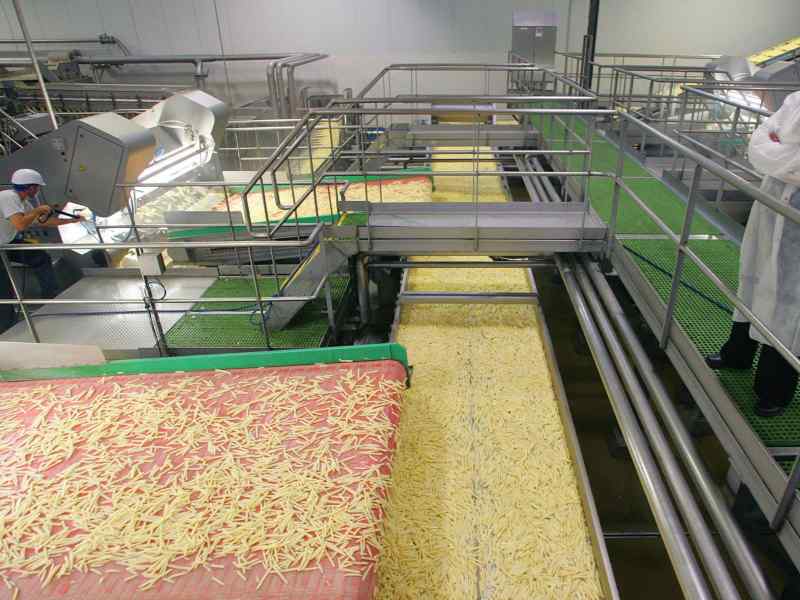
A 2023 installation in Poland processing Bintje variety potatoes demonstrates the correlation between engineering parameters and shelf life outcomes. The line operates at 4.8 tons per hour with 94.7% yield efficiency. Quality audits after 18 months frozen storage show zero lipid oxidation and maintained texture profile.
| Parameter | Design Value | Actual Performance | Impact on Shelf Life |
|---|---|---|---|
| Blanching Temperature | 85°C ±1°C | 84.8°C ±0.7°C | +2.3 months stability |
| Core Freezing Time | <15 minutes | 12.4 minutes | +1.8 months stability |
| Moisture Content Post-Dry | 68% ±2% | 67.5% ±1.2% | +1.1 months stability |
| Package O2 Residual | <0.5% | 0.38% | +3.2 months stability |
| Storage Temperature | -18°C ±0.5°C | -18.2°C ±0.3°C | +4.1 months stability |
The cumulative effect of these controlled parameters extends guaranteed shelf life from industry standard 12 months to 24 months. Energy consumption averages 0.85 kWh per kilogram of finished product, with refrigeration accounting for 62% of total power demand. This installation serves major quick-service restaurant chains across Germany and Scandinavia.
Engineering FAQ: Shelf Life Optimization
Why do my frozen fries develop freezer burn after 6 months?
Freezer burn indicates moisture migration due to temperature fluctuations above -15°C or inadequate packaging barrier. Install data loggers to confirm storage stability within ±0.5°C variance. Upgrade packaging film to metallized PET with oxygen transmission rate below 10 cc/m²/24h. Check heat seal integrity using burst pressure testing at 0.6 bar.
What causes texture degradation during extended storage?
Starch retrogradation and ice crystal growth damage cellular structure. Ensure blanching temperature reaches 85°C for full enzyme deactivation. Verify IQF freezer achieves -35°C evaporating temperature to create micro crystals. Maintain water activity below 0.85 through precise drying control. These three parameters collectively preserve texture for 24 months.
How does potato variety selection impact shelf life engineering?
High dry matter varieties like Russet Burbank or Innovator contain 21-23% solids, reducing moisture load on freezing systems. These varieties exhibit lower reducing sugar content, minimizing Maillard reaction during storage. Processing lines calibrated for 22% solid content achieve 15% faster freezing and extended stability compared to wet varieties with 17% solids.
What automation level is required for consistent shelf life results?
Full PLC control with SCADA integration ensures parameter repeatability within ±2% variance. Manual operations create 12-15% deviation in blanching time and temperature, directly reducing shelf life by 4-6 months. Automated lines with 6 inspection stations and real-time data logging maintain certification standards for BRCGS and ISO 22000 compliance.