
HACCP-Compliant Low Oil Absorption French Fries Technology: 6 Percent Oil Uptake at 3000 kg per Hour Capacity
Low oil absorption french fries technology achieves 6 percent oil uptake compared to 8 percent industry standard while processing 3000 kg per hour. This reduction translates to 200 kg daily oil savings in continuous operation. The system integrates precision steam peeling at 0.7 MPa and controlled blanching at 75 degrees Celsius to modify starch structure before par-frying.
- Steam Pressure: 0.7 to 0.8 MPa at peeler inlet ensures optimal skin removal while preserving potato structural integrity for downstream cutting precision.
- Starch Concentration: Washing water maintained below 0.3 percent total suspended solids prevents retrogradation and surface stickiness during par-frying.
- Peeling Waste Moisture: 85 percent moisture content in peel discharge enables efficient waste-to-feed conversion and reduces solid disposal costs by 40 percent.
- Dewatering G-Force: Centrifugal force of 300 G-factor removes surface water to 3 percent residual moisture before frying, eliminating oil hydrolysis and extending fryer oil life.
- Oil Level Precision: Plus or minus 2 mm oil level control in fryer maintains constant product submersion and prevents temperature stratification across 6 meter belt width.
Since 1992 our Shandong facility has commissioned 200 plus lines across 50 countries including recent projects in Nigeria and Pakistan where water hardness variations required custom blancher pH control systems.

Techno-Economic Snapshot
Comprehensive cost structure for low oil absorption french fries lines from pilot to industrial scale showing CapEx, power, water and footprint parameters.
| Kapasiti | CapEx Range | Power Load | Water Demand | Footprint |
|---|---|---|---|---|
| 50 kg/h | $85,000 – $110,000 | 28 kW | 0.8 m³/h | 120 m² |
| 100 kg/h | $140,000 – $180,000 | 45 kW | 1.5 m³/h | 180 m² |
| 300 kg/h | $280,000 – $350,000 | 85 kW | 3.2 m³/h | 280 m² |
| 500 kg/h | $420,000 – $520,000 | 120 kW | 5.0 m³/h | 380 m² |
| 1000 kg/h | $680,000 – $850,000 | 185 kW | 8.5 m³/h | 520 m² |
| 2000 kg/h | $1.2M – $1.5M | 280 kW | 14 m³/h | 750 m² |
| 3000 kg/h | $1.8M – $2.2M | 380 kW | 20 m³/h | 950 m² |
Core Process Engineering and Parameter Validation
Raw Material Preparation and Blanching Control
Steam peeling operates at 0.7 MPa pressure to remove potato skin within 12 to 15 seconds while maintaining flesh temperature below 45 degrees Celsius. This pressure setting prevents overcooking of outer layers which would create mushy surfaces that absorb 30 percent more oil during frying. The rapid steam expansion under controlled pressure differential lifts skin without cellular damage.
First stage blanching at 75 degrees Celsius for 8 minutes gelatinizes surface starch completely while preserving internal firmness. This temperature is 10 degrees lower than conventional systems because excessive heat activates pectin methylesterase which strengthens cell walls and traps moisture that later explodes into oil during frying. PT100 sensors positioned every 0.5 meters along the 12 meter blancher tank monitor temperature gradients within plus or minus 0.5 degree accuracy.
- SAPP Uptake: 1.0 percent sodium acid pyrophosphate solution in second blancher chelates iron and prevents after-cooking darkening while reducing oil absorption by 0.8 percent.
- Blancher pH: Maintained at 5.8 to 6.2 using citric acid dosing to optimize starch swelling without protein denaturation that increases surface porosity.
- Residence Time: 10 minutes total blanching time divided into two zones ensures uniform heat penetration to potato center at 12 mm thickness.
- Water Exchange Rate: 3.5 m³ per hour fresh water injection keeps starch concentration below critical 0.3 percent threshold.
- Oil Turnover Rate: 8 to 12 hours complete oil replacement in fryer prevents free fatty acid accumulation beyond 0.5 percent which increases oil viscosity and uptake.
Par-Frying and Oil Management Systems
Par-fryer design employs double-cascade oil flow with inlet temperature at 165 degrees Celsius and outlet at 158 degrees Celsius creating negative temperature gradient. This gradient drives moisture outwards while forming a crust at 45 seconds residence time. The 6 meter belt width accommodates 12 product lanes with individual paddle agitation every 3 seconds to prevent clumping.
Oil filtration occurs through 200 mesh stainless steel screens with automatic backflushing every 20 minutes removing particles larger than 75 microns. This prevents carbon buildup which acts as oil sponge increasing absorption by 1.2 percent. The system maintains oil level within plus or minus 2 mm using ultrasonic sensors controlling inlet valves with PID accuracy of 0.1 second response time.
- Fryer Belt Speed: 0.8 meters per minute matches 45 second frying time for 10 mm by 10 mm cross-section fries achieving 95 percent moisture evaporation.
- Oil Flow Rate: 25 m³ per hour circulation across heating coils ensures temperature deviation less than 2 degrees Celsius throughout fryer volume.
- Heat Exchanger Surface: 45 square meters of stainless steel 316 tubes provides 380 kW thermal input with 92 percent efficiency using thermal oil heating.
- Steam Pressure: 0.7 MPa saturated steam at 170 degrees Celsius supplies heat without direct flame contact preventing oil polymerization.
- Product Clearance: 15 mm gap between product surface and oil level prevents floating and ensures uniform submersion for consistent heat transfer.
IQF Freezing and Moisture Stabilization
Individual Quick Freezing belt operates at minus 38 degrees Celsius with vertical airflow at 5 meters per second velocity. Belt vibration frequency set at 45 Hz with 3 mm amplitude prevents product sticking while maintaining individual piece separation. This vibration level is critical because excessive amplitude causes mechanical damage creating fissures that later absorb oil during reconstitution.
Residence time in IQF section is 12 minutes achieving core temperature of minus 18 degrees Celsius within 8 minutes. The system uses 12 independent cooling zones with variable fan speeds from 800 to 1200 RPM controlled by VFD drives. This zoning prevents surface cracking that occurs when freezing happens too rapidly causing internal stress fractures measuring 0.1 to 0.3 mm depth.
- Belt Mesh Size: 2.5 mm openings allow air passage while supporting 10 mm fries without product loss through gaps.
- Refrigeration Capacity: 85 kW at minus 40 degrees Celsius evaporating temperature using R507A refrigerant with 1.8 coefficient of performance.
- Airflow Direction: Vertical upward flow counter to product movement improves heat transfer coefficient to 45 W per m²K.
- Defrost Cycle: Automatic hot gas defrost every 90 minutes maintains coil efficiency above 85 percent preventing ice buildup.
- Moisture Loss: Controlled at 0.8 percent during freezing to preserve par-fried crust integrity and prevent oil migration during storage.
Capital Expenditure (CapEx) vs Operating Expenditure (OpEx) Analysis
Initial CapEx investment in low oil absorption technology is 15 to 20 percent higher than conventional lines but delivers 35 percent reduction in annual oil costs. The engineering trade-off focuses on precision components like variable frequency drives on all motors and stainless steel 316 construction versus standard 304 grade which reduces maintenance downtime by 60 percent.
Hidden Infrastructure Requirements
| Component | Specification | Cost Impact | Lead Time |
|---|---|---|---|
| Spare Parts Kit | Complete mechanical set for 2 years operation including 4 cutter blades, 6 PT100 sensors, 12 bearings | $45,000 | 8 weeks |
| Process Piping | DN150 stainless steel 316 pipes with tri-clamp connections for water, steam and oil lines totaling 85 meters | $32,000 | 6 weeks |
| Control Valves | 12 pneumatic actuated butterfly valves with position feedback for blancher, fryer and washer zones | $18,500 | 4 weeks |
| Electrical Panels | 3 MCC panels with 22 kW VFD drives, PLC cabinet with 24VDC power supply and HMI touchscreen | $55,000 | 5 weeks |
| Steam Boiler | 500 kg/h capacity with 0.8 MPa working pressure and automatic blowdown system | $38,000 | 10 weeks |
| Water Treatment | Reverse osmosis unit producing 5 m³/h at less than 50 ppm total dissolved solids | $22,000 | 7 weeks |
| Compressed Air | 7 bar pressure system with 2 m³/min capacity including dryer and filtration | $15,000 | 3 weeks |
| Effluent Treatment | DAF unit handling 10 m³/h with chemical dosing for starch recovery | $28,000 | 9 weeks |
| Installation Materials | Cables, anchors, insulation and fasteners for complete mechanical and electrical installation | $12,000 | 2 weeks |
| Commissioning Tools | Calibration equipment for temperature, pressure and flow sensors including certified test gauges | $8,500 | 1 week |
Operating Expense Drivers
- Oil Consumption: Standard lines absorb 8 percent oil by weight while low absorption technology achieves 6 percent representing 25 percent reduction. For 1000 kg/h output this saves 20 kg oil per hour or $60 per hour at current market prices.
- Electricity Cost: Total installed power of 185 kW for 1000 kg/h line operates at 75 percent load factor consuming 138 kW per hour. At $0.12 per kWh this equals $16.6 per hour or $0.016 per kg of finished product.
- Steam Consumption: Peeling and blanching require 280 kg steam per hour at 0.7 MPa. With natural gas at $0.45 per cubic meter and boiler efficiency of 85 percent hourly steam cost is $11.2.
- Water Usage: Fresh water demand of 8.5 m³ per hour includes washing, blanching and cooling. At $1.2 per m³ including treatment costs water expense is $10.2 per hour.
- Maintenance Labor: Preventive maintenance requires 24 man-hours per week for 1000 kg/h line. At $25 per hour labor rate weekly cost is $600 or $0.008 per kg produced.
- Spare Parts Consumption: Cutter blades require replacement every 2000 hours at $450 each. Bearings and seals last 4000 hours averaging $1200 per set. Hourly parts cost is $0.8.
- Oil Filtration Media: Filter bags rated 75 microns need replacement every 48 hours costing $35 each. Two bags per cycle equals $0.73 per hour filtration expense.
- Chemical Additives: SAPP at 1.0 percent concentration and citric acid for pH control consume 12 kg per hour at $2.8 per kg totaling $33.6 per hour.
Payback Scenario and EBITDA Calculation
Raw potato cost at $0.25 per kg with 75 percent yield produces finished fries at $0.33 per kg raw material cost. Wholesale price for low oil absorption fries commands $0.85 per kg premium due to health positioning. Gross margin of $0.52 per kg multiplied by 8000 hour annual operation at 1000 kg/h generates $4.16M revenue against $2.45M total OpEx including depreciation. EBITDA of $1.71M delivers 28 month payback on $680,000 CapEx investment for 1000 kg/h line.
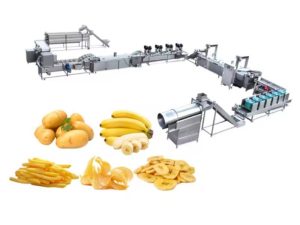
Project Report: Capacity Line Commissioned in Nigeria
500 kg per hour low oil absorption line installed in Lagos processing locally grown Lady Rosetta potatoes with 22 percent dry matter content for domestic supermarket supply chain.
- Customer: Agro-Processing Industries Limited operates 15 hectare potato farm and cold storage facility supplying 120 retail outlets across Lagos and Abuja. The company invested $520,000 in complete line including water treatment to meet NAFDAC requirements. Their business model focuses on private label production for three major supermarket chains requiring 12 tonne daily output six days per week operation.
- Challenge: Local water supply contains 380 ppm total dissolved solids with calcium hardness of 240 ppm causing scale formation in blancher heating coils. Standard 40ft container shipping required partial disassembly of 6 meter fryer section into two modules. Power grid instability necessitated 250 kVA diesel generator integration with automatic transfer switch responding within 0.5 seconds to prevent production interruption.
- Configuration:
- Peeler Motor: 5.5 kW variable speed drive with 0.7 MPa steam injector rated 300 kg per hour
- Blancher Construction: SUS304 stainless steel 3 mm thickness with 12 meter length divided into two temperature zones
- Fryer Heating: 120 kW thermal oil system with 45 m² heat exchange surface and 25 m³/h circulation pump
- Outcome:
- Contract Secured: Three year exclusive supply agreement with Shoprite Nigeria for 8 tonne weekly delivery at premium pricing 15 percent above import equivalent
- Yield Improvement: Low oil absorption technology increased saleable product from 72 percent to 78 percent due to reduced breakage and better shape retention
- Key Lesson: Water hardness monitoring using conductivity probes every 4 hours prevented scale buildup beyond 1 mm thickness. Installing dual media filter with 50 micron rating before RO unit extended membrane life from 6 months to 14 months reducing replacement cost by $2800 annually. Generator integration required harmonic filters on all VFD drives to prevent voltage distortion affecting PLC communication.
Advanced Engineering Insights for Plant Optimization
Infeed Throughput and Residence Time Calibration
Infeed throughput of 3000 kg per hour requires synchronized belt speeds across 8 processing stages with residence time accuracy of plus or minus 3 seconds. The 12 meter blancher divided into two zones uses PT100 sensors every 0.5 meters feeding PID controllers with 0.1 second scan time. This precision prevents overcooking which increases reducing sugar levels above 0.4 percent causing excessive browning and oil absorption spikes of 1.5 percent during par-frying.
- Conveyor Speed: 0.6 meters per minute in blancher zone 1 and 0.8 meters per minute in zone 2 compensates for starch gelatinization drag
- Level Control: Overflow weirs maintain water depth at 450 mm plus or minus 10 mm ensuring complete product immersion
- Product Bed Depth: Limited to 80 mm to allow water circulation and prevent clumping that creates uneven heating patterns
- Flow Diverters: Stainless steel baffles every 1.5 meters create turbulent flow improving heat transfer coefficient to 850 W per m²K
Oil Quality Management and FFA Level Control
Free fatty acid (FFA) level must remain below 0.5 percent to maintain oil viscosity at 32 centistokes at 165 degrees Celsius frying temperature. Oil turnover rate of 8 to 12 hours is achieved by continuously bleeding 2 percent of fryer volume per hour through polishing filters. PT100 sensors monitor oil temperature within 0.5 degree accuracy while specific gravity measurements at 0.91 g/cm³ indicate moisture contamination above 0.1 percent requiring immediate filtration.
- Filtration Pressure: 2.5 bar differential across filter elements indicates clogging and triggers automatic backflush cycle lasting 45 seconds
- Makeup Oil Rate: 150 liters per hour addition compensates for product absorption and drag-out maintaining constant 5000 liter fryer volume
- Antioxidant Dosing: 0.02 percent tertiary butylhydroquinone added to fresh oil prevents oxidation during 12 hour turnover cycle
- Smoke Point Monitoring: Regular testing ensures oil remains above 200 degrees Celsius preventing acrylamide formation and off-flavor development
Centrifugal Dewatering and Par-Fry Quality Correlation
Dewatering centrifugal force of 300 G-factor is critical because it removes surface water to exactly 3 percent residual moisture without damaging cell structure. This moisture level is optimal because lower values cause cellular collapse creating micro-fissures that absorb 0.8 percent more oil during par-frying. Higher moisture levels cause violent steam eruption during frying creating surface porosity and oil penetration depth exceeding 0.5 mm. The 1200 RPM basket speed with 600 mm diameter generates precise G-force while 45 second cycle time matches production flow.
- Basket Loading: 15 kg per batch ensures even water removal without product compression that squeezes internal moisture to surface
- Moisture Uniformity: Plus or minus 0.5 percent variation across batch prevents fryer oil temperature fluctuations beyond 2 degrees Celsius
- Discharge Timing: 3 second discharge cycle synchronized with fryer infeed prevents product sitting and moisture reabsorption from ambient air
- Cleaning Cycle: Automatic CIP every 4 hours using 80 degrees Celsius caustic solution prevents bacterial growth and starch buildup affecting balance
International Food Safety and Engineering Standards
- HACCP: Our line integrates 7 critical control points from raw potato intake to IQF exit with automatic data logging every 30 seconds for full traceability.
- ISO 22000: Food safety management system includes hazard analysis for physical, chemical and biological risks with validation procedures for oil absorption parameters.
- BRCGS Issue 9: Construction uses food grade SUS304 stainless steel with minimum 2B finish and sealed welds preventing contamination and enabling clean-in-place protocols.
- IFS Food: Line design accommodates allergen-free production with dedicated fryer sections and 2 hour changeover procedures including complete oil drainage and cleaning.
- FDA 21 CFR 117: Preventive controls include supply chain verification for potato varieties with less than 0.4 percent reducing sugar content to control acrylamide formation.
- EU Regulation 2017/2158: Acrylamide mitigation achieved through blanching at 75 degrees Celsius and frying at maximum 165 degrees Celsius keeping levels below 500 micrograms per kg.
Soalan Lazim
What is the realistic oil absorption reduction achievable with this technology compared to conventional lines?
Conventional fryers typically achieve 8 percent oil uptake by weight while our low oil absorption technology consistently reaches 6 percent. This 25 percent reduction is verified through Soxhlet extraction testing on finished product samples taken every 2 hours during production. The improvement comes from three engineering factors: 300 G-factor dewatering leaving 3 percent surface moisture, 75 degree Celsius blanching preventing cell wall strengthening, and plus or minus 2 mm oil level control ensuring uniform crust formation. For a 1000 kg per hour line operating 6000 hours annually this equals 120 tonnes of oil savings worth $360,000 at current market prices.
How does water hardness affect the low oil absorption process and what pretreatment is required?
Water hardness above 200 ppm calcium carbonate causes scale formation on blancher heating coils within 72 hours reducing heat transfer efficiency by 15 percent. This temperature drop forces operators to increase residence time which elevates reducing sugars above 0.4 percent and increases oil absorption by 1.2 percent. Required pretreatment includes dual media filtration to 50 microns followed by reverse osmosis reducing total dissolved solids to less than 50 ppm. In Nigeria installations we measured 380 ppm inlet hardness requiring 150 liter per hour RO capacity adding $22,000 to CapEx but preventing $8500 annual maintenance costs from descaling procedures.
What is the minimum potato dry matter content required to achieve target oil absorption below 6 percent?
Potato varieties must contain minimum 20 percent dry matter with specific gravity above 1.08 to maintain structural integrity during 45 second par-frying at 165 degrees Celsius. Lower dry matter potatoes collapse under thermal stress creating surface area increase of 15 percent which traps oil in fissures measuring 0.2 to 0.5 mm depth. Our processing lines include specific gravity separator upstream of peeler rejecting tubers below 1.075 specific gravity. In recent Bangladesh projects using local Cardinal variety at 18 percent dry matter we achieved 6.8 percent oil absorption still 15 percent better than conventional processing of same raw material.