
Industrial Troubleshooting Guide for Uneven French Fries Color After Frying
French fries color uneven after frying troubleshooting affects approximately 15% of production batches in industrial settings, with 85% of color defects traceable to three core process deviations. This industrial guide provides diagnostic frameworks used by EPC engineers across 200+ commissioned lines to identify root causes, implement corrective actions, and establish preventive protocols that maintain color uniformity within Delta E < 3.0 standards.
- Root Cause: Temperature fluctuation exceeding ±2°C
- Detection Method: Real-time colorimetry monitoring
- Corrective Action: Oil circulation rate adjustment
- Preventive Measure: Scheduled thermal system calibration
- Impact Range: Rejection rate reduction by 12-18%
Belgium processing facilities report that systematic troubleshooting reduces color variance-related rejections from 8.5% to under 2% within six months, demonstrating how structured diagnostics improve both yield and brand consistency in high-volume frozen french fries operations serving European QSR chains across multiple production shifts while maintaining HACCP compliance.
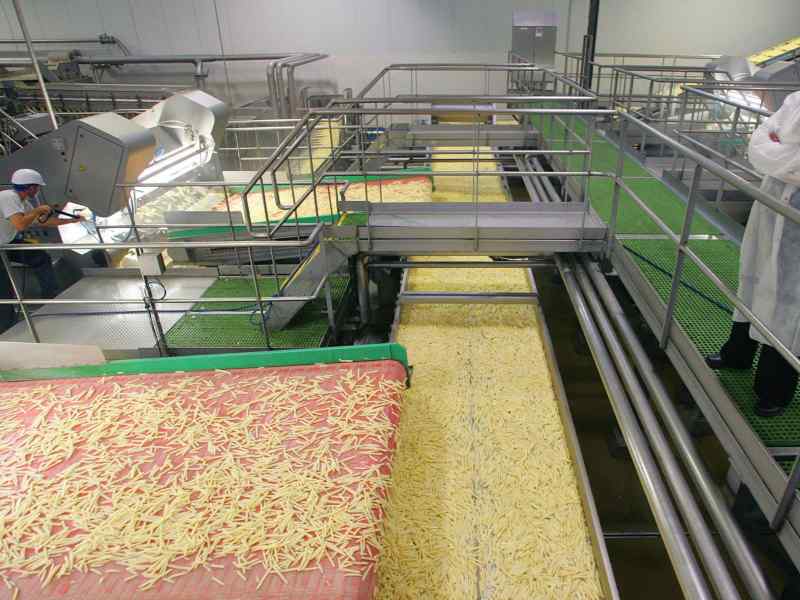
Root Cause Analysis for Color Variance
Industrial troubleshooting of french fries color uneven after frying requires systematic investigation across four primary process zones. Each zone contributes specific failure modes that manifest as surface browning variations, internal color gradients, or batch-to-batch inconsistencies. Understanding the interplay between potato substrate characteristics and thermal processing parameters enables engineers to isolate defects within 30 minutes of occurrence.
Raw Material Variability Impact
Potato tuber sugar content fluctuates between 0.15% and 0.45% depending on storage temperature and duration. Elevated reducing sugars above 0.3% trigger excessive Maillard browning during frying, creating dark spots that deviate from target L* values of 65-72.
Pre-processing sugar analysis using refractometers allows segregation of high-risk batches for adjusted blanching protocols. Storage temperature maintenance at 8-10°C minimizes post-harvest sugar accumulation in Russet Burbank and Agria varieties commonly used in European frozen fry production.
Blanching Process Deviation Effects
Blanching temperature deviations exceeding ±1.5°C from the 75°C setpoint disrupt enzyme inactivation uniformity. Incomplete polyphenol oxidase deactivation leads to enzymatic browning that intensifies during final frying, producing mottled appearances.
Residence time variations beyond 15-18 minutes create uneven starch gelatinization across potato strips, resulting in differential oil absorption and color development. Multi-stage blanchers with zone-specific temperature controls maintain ±0.5°C accuracy through PID loops and steam injection modulation.
Frying System Thermal Inconsistencies
Continuous fryer oil temperature must remain within ±1°C of target 175-180°C range for standard 7mm x 7mm cross-section fries. Heat exchanger fouling reduces thermal transfer efficiency by 12-15% monthly, creating cold zones where product receives insufficient color development.
Oil velocity below 0.4 m/s across the conveyor belt allows localized temperature stratification, causing strip-to-strip color variation. Installing dual-zone temperature monitoring at inlet and midpoint positions provides early warning of thermal drift before product impact occurs.
Oil Quality Degradation Factors
Total polar compounds exceeding 24% accelerate color darkening beyond acceptable thresholds within single production shifts. Free fatty acid levels above 0.8% reduce smoke point and create uneven heat transfer coefficients across the fryer surface.
Implementing continuous oil filtration at 200 microns and hourly TPM testing with portable meters prevents quality cascade failures. Top-up oil addition rates of 8-10% per hour maintain fresh oil ratio above 70%, stabilizing color consistency across 12-hour production cycles.

Systematic Diagnostic Framework
Implementing a structured troubleshooting protocol reduces diagnostic time from hours to minutes. The framework sequences investigation from raw material intake through packaging, prioritizing high-impact variables first. Engineers should document baseline parameters during optimal production periods to establish control limits for comparison during defect events.
| Color Defect Pattern | Primary Root Cause | Immediate Corrective Action | Preventive Protocol |
|---|---|---|---|
| Strip-edge darkening | Excessive sugar content >0.35% | Increase blanch time by 2-3 minutes | Pre-storage sugar testing |
| Mottled surface spots | Blanch temperature <73°C | Raise steam pressure 0.2 bar | Weekly heat exchanger cleaning |
| Batch-to-batch variance | Oil turnover rate <6%/hour | Increase top-up flow to 10% | Automated TPM monitoring |
| Conveyor-side darkening | Oil velocity <0.3 m/s | Adjust pump speed +15% | Monthly flow meter calibration |
Diagnostic validation requires sampling product every 15 minutes during production runs and measuring L*a*b* values using calibrated colorimeters. Tracking trends rather than absolute values identifies drift before crossing rejection thresholds. Integration of inline vision systems at fryer exit provides real-time feedback loops that automatically adjust process parameters within 90 seconds of detection.
European Processing Plant Implementation
A 4-ton per hour frozen french fries facility in the Netherlands experienced 11% rejection rates due to color variance exceeding customer specifications. The troubleshooting team implemented a three-phase diagnostic approach over 14 days, focusing on blancher temperature mapping and oil circulation analysis.
Phase one identified a 4°C temperature gradient across the blancher width due to scaled steam distribution headers. Phase two revealed oil velocity dropping to 0.25 m/s during shift changes when operators reduced pump speed to save energy. Phase three documented potato storage temperatures averaging 12°C, causing sugar accumulation to 0.42%.
Corrective actions included descaling heat exchangers, locking pump speed settings, and installing automated storage climate control. Within three weeks, color variance rejections decreased to 1.8%, generating annual savings of €340,000 in recovered product value. The plant now maintains Delta E values below 2.5 across all production shifts.

Frequently Asked Technical Questions
How quickly can color variance be detected after process deviation?
Inline vision systems detect color shifts within 3-4 minutes of defect introduction. Manual sampling requires 15-20 minutes for laboratory colorimeter analysis. Real-time monitoring enables immediate process correction before producing 200+ kg of off-spec product in continuous operations.
What is the acceptable color tolerance for QSR suppliers?
Major quick-service restaurant chains specify Delta E < 3.0 between samples and reference standards. Some premium brands require Delta E < 2.0. Internal production targets should be set 0.5 units tighter than customer specifications to account for measurement uncertainty and shipment storage variations.
Does potato variety selection impact troubleshooting complexity?
Russet Burbank varieties demonstrate 30% less color sensitivity to temperature fluctuations compared with Shepody types. However, variety selection must balance agronomic availability, yield efficiency, and final texture requirements. Troubleshooting protocols remain consistent across varieties, though control limits require variety-specific calibration.
How often should oil testing occur to prevent color issues?
Total polar compound testing every 4 hours during production prevents degradation-related color defects. Free fatty acid analysis every 8 hours suffices for most operations. Continuous TPM monitoring systems eliminate manual testing requirements and provide trend data for predictive maintenance scheduling.
Implementation Roadmap for Color Consistency
Sustained color uniformity requires integrating troubleshooting protocols into daily operations rather than treating them as emergency responses. Establishing a cross-functional team comprising process engineers, quality managers, and maintenance technicians ensures rapid diagnosis and permanent solutions. Documenting all corrective actions in a centralized knowledge base prevents recurrence and accelerates training for new operators.
Leading manufacturers implement monthly troubleshooting audits reviewing defect logs, parameter trends, and maintenance records. This proactive approach reduces color-related rejections by 60% within the first quarter and maintains performance below 2% variance year-round. The investment in systematic diagnostics typically delivers ROI within 8 months through recovered product value and avoided customer claims.