
Frozen French Fries Moisture Content: Technical Specifications for Industrial Production Lines
The moisture content of frozen french fries directly determines product quality, frying efficiency, and storage stability in large-scale industrial operations. For B2B manufacturers supplying quick-service restaurants and retail chains, maintaining precise moisture levels between 70-75% represents a critical engineering parameter that impacts yield, energy consumption, and final customer satisfaction across global markets.
- Key Signal 1: Industrial capacity: 1-5 tons per hour processing lines require precise moisture control
- Key Signal 2: Cost impact: Moisture variation affects 8-12% of final product yield and profitability
- Key Signal 3: Efficiency factor: Optimized drying reduces freezing energy consumption by 15-20%
- Key Signal 4: Market standard: 70-75% moisture content meets global QSR specifications
- Key Signal 5: Equipment dependency: Centrifugal dryers and air knife systems control final levels
Understanding these technical parameters enables factory managers and procurement directors to specify equipment correctly, validate supplier capabilities, and ensure consistent product quality across multiple production batches and seasonal raw material variations.

Fundamentals of Moisture Content in Frozen French Fries
Moisture content in frozen french fries refers to the percentage of water retained in the potato strip after complete processing and before final packaging. This measurement includes both free water and bound water within the cellular structure. Industrial specifications typically target 70-75% moisture content for standard cut fries, though this varies based on final product type, customer requirements, and intended frying method.
Defining Moisture Content Specifications
Technical specifications define moisture content on a wet weight basis, calculated as (water weight / total weight) × 100. For industrial production, this parameter is contractually agreed upon between manufacturers and buyers. Quick-service restaurant chains often require 72±2% moisture content to ensure consistent frying times across thousands of locations. Retail frozen products may accept slightly higher moisture levels up to 75% depending on packaging and distribution conditions.
Why Moisture Content Matters for Industrial Production
Excessive moisture above 76% causes several production issues: increased freezer load, higher energy costs, clumping during packaging, and excessive oil splattering during final frying. Insufficient moisture below 68% results in poor texture, reduced yield per ton of raw potatoes, and potential quality rejection. The optimal range balances product quality with operational efficiency and raw material utilization.
Production Line Impact on Final Moisture Levels
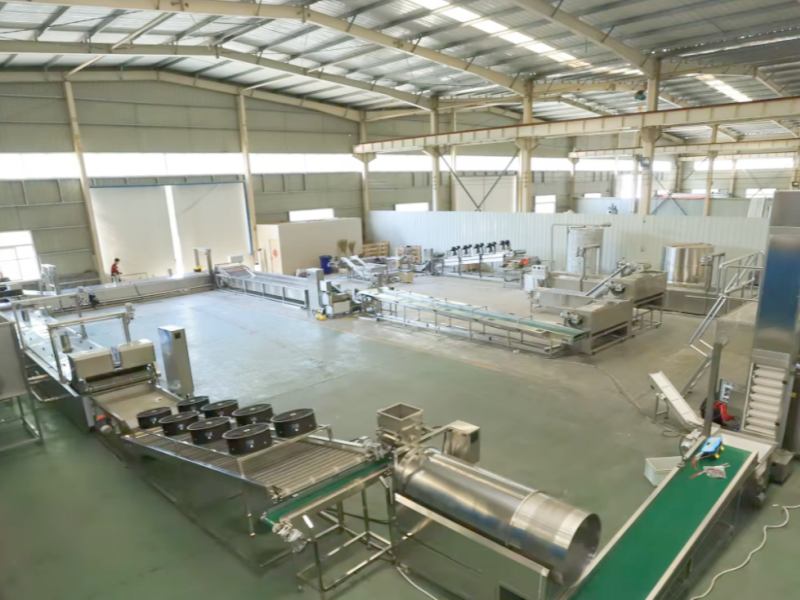
Every stage of the production line influences final moisture content. Washing introduces surface water, blanching adds thermal energy that gelatinizes starch and opens cellular structures, drying removes controlled amounts of water, and freezing locks the final moisture level in place. Equipment selection and parameter settings at each stage must be coordinated as an integrated system.
Blanching Process and Water Retention
Industrial blanching at 85-95°C for 2-4 minutes partially cooks the potato strips and activates pectin methylesterase, which strengthens cell walls and reduces moisture loss during subsequent frying. The blanching water temperature, pH level, and residence time directly affect how much water the potato tissue will retain. Over-blanching leads to excessive moisture uptake and cellular breakdown, while under-blanching results in poor texture and uneven moisture distribution.
Drying Stage Engineering Parameters
The drying stage represents the primary control point for final moisture content. Centrifugal dryers operating at 300-400 RPM remove surface water within 30-45 seconds, reducing moisture by 3-5 percentage points. Air knife systems with 15-25 m/s velocity and 60-80°C temperature further reduce surface moisture without penetrating the product interior. The combination of mechanical and thermal drying achieves the target 70-75% range consistently across production runs.
Freezing Technology and Moisture Lock
Fluidized bed freezers operating at -35°C to -40°C freeze the product within 8-12 minutes, locking the moisture content at the desired level. Rapid freezing forms small ice crystals that minimize cellular damage and prevent moisture migration during storage. Slow freezing would allow water to redistribute and create large ice crystals, resulting in texture degradation and increased moisture loss during final preparation.
Equipment Configuration for Optimal Moisture Control
Selecting and configuring the right equipment combination determines whether a production line can maintain consistent moisture content within specification tolerances. Capacity matching between washing, blanching, drying, and freezing units prevents bottlenecks that cause product dwell time variations and moisture fluctuations.
Dryer Specifications and Capacity Matching
Centrifugal dryers must be sized for the full production rate, typically 1.5 times the nominal capacity to allow for peak loads and maintenance cycles. A 2-ton per hour line requires a dryer with 3-ton capacity rating. Air knife systems need adjustable velocity and temperature controls to accommodate different potato varieties and seasonal sugar content variations that affect moisture retention.
Freezer System Integration
The freezer must maintain consistent product bed depth and air velocity across the entire belt width. Uneven airflow creates moisture gradients within the product, with some fries freezing faster than others. Modern fluidized bed freezers include zone control systems that adjust air distribution and temperature in three separate sections, ensuring uniform moisture lock across all product streams.

Quality Control and Measurement Protocols
Industrial operations require continuous moisture monitoring rather than periodic laboratory sampling. Modern production lines integrate in-line moisture meters that use near-infrared spectroscopy to measure every product batch in real time, enabling automatic adjustment of dryer parameters.
In-Line Moisture Monitoring Systems
Near-infrared sensors installed after the drying stage measure moisture content with ±0.5% accuracy at line speeds up to 5 tons per hour. These systems feed data directly to the programmable logic controller, which automatically adjusts centrifugal dryer speed and air knife temperature. This closed-loop control maintains moisture content within the target range despite variations in raw potato solids content, which can range from 18-24% depending on variety and harvest conditions.
Laboratory Testing Standards
While in-line systems provide continuous monitoring, laboratory verification using AOAC Official Method 934.06 remains the reference standard. Samples are collected every two hours, weighed, dried in a vacuum oven at 70°C for 16 hours, and reweighed to calculate moisture content. This method provides absolute accuracy for calibration of in-line sensors and validation of production records for customer audits.
Real-World Application: European Processing Facility
A 3-ton per hour facility in Poland processing Bintje and Innovator varieties implemented a three-stage moisture control system to meet McDonald’s supplier specifications. The line includes a 400 RPM centrifugal dryer, dual-zone air knife system with independent temperature control, and NIR moisture monitoring with automatic feedback.
During the first production season, the facility achieved 72.3% average moisture content with a standard deviation of 1.2%, well within the required ±2% tolerance. Energy consumption for the freezing stage decreased by 18% compared to their previous line without precise moisture control. The system compensated for raw material variations by automatically increasing air knife temperature by 5°C when incoming potato solids content dropped below 20%, maintaining consistent final product quality.
The installation included training for quality control staff on calibration procedures and troubleshooting protocols. After six months of operation, the facility reported zero customer rejections due to moisture content deviations, compared to three rejections in the previous year with their old equipment.
Frequently Asked Questions
How does potato variety affect final moisture content?
High-solid varieties like Russet Burbank naturally contain less moisture and require gentler drying to avoid over-removal. Low-solid varieties such as early harvest potatoes retain more water and need extended drying time. Production lines must have adjustable parameters to accommodate these differences without equipment changeover.
What is the relationship between moisture content and oil uptake during final frying?
Moisture content and oil uptake have an inverse relationship in industrial applications. Fries with 70-72% moisture content absorb 12-15% oil during final frying, while moisture levels above 75% increase oil uptake to 18-22%. This directly impacts nutritional labeling and cost per serving for quick-service restaurant chains.
Can moisture content be adjusted after freezing?
No, moisture content cannot be practically adjusted post-freezing. The freezing process locks water as ice within the cellular structure. Any attempt to modify moisture after freezing would require thawing, which degrades product quality and creates food safety risks. All moisture control must occur during the drying stage before freezing.
How often should in-line moisture sensors be calibrated?
Near-infrared moisture sensors require calibration against laboratory reference methods every 48 hours of operation. Additionally, calibration must be performed whenever potato variety changes or after any maintenance on the drying equipment that could affect product flow characteristics or sensor positioning.