
HACCP-Compliant Mid-Scale French Fries Factory Between 100000 And 500000 Usd With Precision Thermal Control
A Mid-Scale French Fries Factory Between 100000 And 500000 Usd typically processes 500 to 1500 kilograms of raw tubers hourly while maintaining oil temperature variance within plus or minus 1.5 degrees Celsius. These systems integrate continuous washing drums with abrasive peelers operating at 0.7 megapascals steam pressure to achieve 95 percent skin removal efficiency without flesh loss.
- Steam Pressure: 0.7 to 0.8 MPa at peeler inlet ensures complete cambium layer removal
- Starch Concentration: 1200 to 1500 ppm in washing water prevents re-deposition
- Peeling Waste Moisture: 85 percent wet basis for optimal waste handling
- Oil Level Precision: plus or minus 2 mm in fryer basin maintains thermal stability
- IQF Belt Frequency: 25 to 30 Hertz vibration prevents clumping during freezing
Since 1992, our Shandong facility has deployed these configurations across emerging markets including Nigeria, Kenya, and Pakistan, where infrastructure constraints demand robust stainless steel construction and modular electrical design suitable for tropical climates and variable grid conditions prevalent in developing economies.

Techno-Economic Snapshot
Mid-scale frozen french fries lines balance capital efficiency with production flexibility, offering throughput tiers from laboratory-scale pilot plants to industrial facilities serving regional distribution networks.
| Kapazität | CapEx Range | Power Load | Water Demand | Footprint |
|---|---|---|---|---|
| 50 kg/h | $80,000-$120,000 | 45 kW | 2.5 m³/h | 120 m² |
| 200 kg/h | $120,000-$180,000 | 85 kW | 4.0 m³/h | 200 m² |
| 500 kg/h | $180,000-$280,000 | 150 kW | 8.0 m³/h | 350 m² |
| 1000 kg/h | $280,000-$380,000 | 220 kW | 15.0 m³/h | 550 m² |
| 1500 kg/h | $350,000-$450,000 | 320 kW | 22.0 m³/h | 750 m² |
| 3000 kg/h | $450,000-$500,000 | 480 kW | 35.0 m³/h | 1200 m² |
Core Process Engineering and Parameter Validation
Steam-Integrated Peeling and Starch Management
The abrasive peeler operates with saturated steam at 0.7 to 0.8 megapascals pressure to soften the periderm before mechanical removal. This dual-action approach reduces flesh loss to less than 8 percent while generating waste with 85 percent moisture content suitable for direct animal feed processing. The steam injection nozzles positioned at 15-degree angles ensure uniform heat penetration through the cambium layer and surrounding cortical tissue without thermal shock.
Washing water recirculation systems maintain starch concentration below 1500 parts per million to prevent redeposition on cut surfaces. High-velocity nozzles operating at 0.3 megapascals pressure create turbulent flow that removes surface starch without damaging cell structure. This parameter is critical because excessive starch residue causes browning during frying and increases acrylamide formation risk in the final frozen product during extended retail distribution cycles in tropical climate conditions.
- Steam Pressure: 0.7 to 0.8 MPa measured at PT100 sensor inlet manifold
- Waste Moisture: 85 percent wet basis enables direct extrusion feeding
- Starch Control: 1200 to 1500 ppm threshold via continuous refractometer monitoring
- Nozzle Pressure: 0.3 MPa cross-flow washing prevents clumping
- Residence Time: 3 to 4 minutes in washing drum ensures complete surface cleaning
Dual-Zone Blanching and Chemical Treatment
First-stage blanching at 75 degrees Celsius initiates starch gelatinization without complete cell wall rupture. This temperature preserves structural integrity during cutting while activating polyphenol oxidase inhibitors naturally present in tuber tissue. The second zone operates at 85 degrees Celsius with 1.0 percent sodium acid pyrophosphate solution uptake to chelate calcium and magnesium ions that cause graying and discoloration in the final packaged retail product appearance specifications for premium grades.
The engineering rationale for differential temperature zoning relates to enzyme kinetics and thermal processing requirements. Pectin methylesterase denaturation requires precise thermal exposure calculated by residence time of 4 minutes at 75 degrees Celsius followed by 2 minutes at 85 degrees Celsius. This profile optimizes texture while minimizing reducing sugar migration to surfaces where Maillard reactions occur during frying and final freezing operations for extended shelf stability requirements in commercial distribution.
- Zone 1 Temperature: 75 degrees Celsius for controlled gelatinization
- Zone 2 Temperature: 85 degrees Celsius with SAPP injection
- SAPP Uptake: 1.0 percent solution concentration by weight
- Residence Time: 4 minutes then 2 minutes sequential processing
- Heat Exchange: Plate-type recuperators recover 70 percent of thermal energy
Continuous Frying and Oil Management
The fryer maintains oil level precision within plus or minus 2 millimeters using ultrasonic sensors coupled with pneumatic filling valves. This accuracy prevents thermal stratification that creates uneven moisture evaporation rates across the product bed. The oil turnover rate of 8 to 12 hours ensures free fatty acid levels remain below 0.5 percent, extending shelf life and reducing polymerization deposits on heat exchanger surfaces and thermal fluid coils significantly over operational cycles.
PID control algorithms modulate thermal input based on product moisture feedback from infrared sensors positioned at the fryer exit. The system responds to 0.5 percent moisture content variations within 30 seconds, maintaining finished product specifications of 4 to 6 percent moisture and 8 percent oil absorption for standard cuts. High-yield configurations achieve 6 percent oil absorption through optimized dewatering pretreatment and enhanced centrifugal force application before thermal processing begins immediately.
- Oil Level Precision: plus or minus 2 mm ultrasonic monitoring
- Turnover Rate: 8 to 12 hours for FFA control
- Temperature Variance: plus or minus 1.5 degrees Celsius across belt width
- Heat Flux: 450 kilowatts per square meter via thermal fluid heating
- Filtration: 50-micron continuous paper filtration with magnetic traps
Capital Expenditure (CapEx) vs Operating Expenditure (OpEx) Analysis
The economic viability of frozen french fries manufacturing depends on balancing initial equipment investment against long-term utility and consumable costs. Mid-scale configurations optimize this trade-off through modular design that permits capacity expansion without complete line replacement.
Hidden Infrastructure Requirements
| Artikel | Cost Range | Technical Specification |
|---|---|---|
| Spare Parts Kit | $8,000-$12,000 | Critical wear components for 2 years operation |
| Steam Boiler Piping | $5,000-$8,000 | Stainless steel 304 headers and insulation |
| Process Water Treatment | $6,000-$10,000 | Reverse osmosis for blanching make-up |
| Electrical Control Panels | $15,000-$25,000 | IP65 rated with VFD drives for all motors |
| Compressor Station | $4,000-$7,000 | 0.6 MPa instrument air for pneumatic valves |
| Waste Handling Conveyor | $3,000-$5,000 | Inclined screw for peel and sliver removal |
| Oil Storage Tanks | $4,000-$6,000 | Double-wall containment for 48 hours supply |
| IQF Refrigeration Piping | $10,000-$15,000 | Ammonia or CO2 lines with insulation |
| Platform and Access Stairs | $7,000-$12,000 | 304 stainless steel catwalks over fryer |
| CIP System Plumbing | $5,000-$8,000 | Caustic and acid wash circulation loops |
Operating Expense Drivers
- Raw Material Cost: Fresh tubers constitute 65 to 70 percent of operating expenditure at $200 to $400 per metric ton depending on season and region.
- Oil Absorption Rates: Standard operations lose 8 percent of product weight as absorbed oil versus 6 percent in optimized lines, representing $80 to $120 daily savings at full capacity.
- Electricity Consumption: Systems consume 0.15 to 0.25 kilowatt-hours per kilogram of finished product, with refrigeration accounting for 40 percent of total load.
- Natural Gas or Biomass: Thermal energy requirements of 1.2 to 1.5 megajoules per kilogram for frying and blanching operations.
- Labor Requirements: Semi-automatic lines require 8 to 12 operators per shift versus 4 to 6 for fully automated configurations.
- Maintenance Intervals: Belt replacement every 8,000 hours, bearing lubrication weekly, and heat exchanger descaling monthly.
- Water Treatment Chemicals: Antiscalants and pH adjustment chemicals cost $0.02 to $0.04 per kilogram of product.
- Packaging Materials: Laminated film bags or bulk totes representing 3 to 5 percent of finished goods value.
Payback Scenario and EBITDA Calculation
Raw potato input costs range from $0.20 to $0.40 per kilogram while wholesale frozen french fries command $1.20 to $2.00 per kilogram depending on cut style and market segment. A 500 kilogram per hour line operating 16 hours daily generates 8,000 kilograms of finished product worth $9,600 to $16,000 daily revenue against $4,800 to $6,400 raw material costs. This margin yields EBITDA of 25 to 35 percent with payback periods of 18 to 30 months for Mid-Scale French Fries Factory Between 100000 And 500000 Usd investments.

Project Report: 800 Kilogram Per Hour Line Commissioned in Nigeria
A Lagos-based agribusiness consortium commissioned an 800 kilogram per hour frozen french fries line to supply domestic quick-service restaurants and retail chains.
- Customer: The client operates integrated farming and food processing operations across southwestern Nigeria with 500 hectares of irrigated potato cultivation. They required a processing solution capable of handling multiple tuber varieties with varying specific gravity and dry matter content while meeting international retail standards for foreign matter and defect counts. The business model focuses on import substitution for previously frozen European products and domestic quick-service restaurant supply chain requirements.
- Challenge: Local infrastructure presented significant constraints including grid voltage fluctuations of plus or minus 15 percent and water hardness levels exceeding 300 parts per million calcium carbonate. Additionally, the 40-foot container shipping limit required modular disassembly of the continuous fryer section and custom crating of the IQF tunnel to prevent damage during ocean transit and local road haulage from Apapa port to the final installation site location nearby.
- Configuration:
- Peeler Motor: 15 kilowatt variable frequency drive with IP55 rating
- Contact Surfaces: SUS304 stainless steel with 2B finish on all food zones
- Control System: Siemens S7-1200 PLC with 10-inch HMI interface
- Outcome:
- Secured three-year supply contract with national supermarket chain requiring 500 kilograms daily delivery
- Achieved 30 percent yield increase over previous batch frying operations through continuous processing and automated sorting
- Key Lesson: The installation required custom voltage stabilization transformers and dedicated water softening pretreatment to protect the plate heat exchangers from scaling. This experience demonstrated that Mid-Scale French Fries Factory Between 100000 And 500000 Usd projects in emerging markets must budget 8 to 12 percent of total capital for utility conditioning equipment not typically required in European installations and developed market contexts with stable infrastructure networks and consistent utility supply standards.
Advanced Engineering Insights for Plant Optimization
Centrifugal Dewatering and Par-Fry Quality
The dewatering centrifuge applies 400 to 600 G-force to remove surface moisture before frying, reducing the thermal load on the fryer and preventing oil degradation. This mechanical removal targets interstitial water held in capillary structures between cells after cutting. Residence time of 30 to 45 seconds at 1200 RPM ensures moisture reduction to 65 to 70 percent wet basis, which is optimal for creating the glassy crust structure during par-frying without excessive oil penetration.
- G-Force Range: 400 to 600 times gravitational acceleration
- Moisture Target: 65 to 70 percent entering fryer inlet
- Basket Perforation: 0.5 millimeter holes prevent product loss
- Vibration Isolation: Rubber mounts prevent structure transmission
Reducing Sugar Management and Color Control
Tuber storage at 8 to 12 degrees Celsius initiates starch-to-sugar conversion, increasing reducing sugar content above 0.5 percent which causes excessive browning during frying. The blanching process must denature enzymes while leaching sugars to below 0.2 percent for consistent golden color. PT100 sensors positioned at three depths in the blancher ensure no cold spots below 70 degrees Celsius exist where enzymatic activity could continue unchecked.
- Sugar Threshold: 0.2 percent maximum for premium color grade
- Storage Temperature: Above 8 degrees Celsius prevents sweetening
- Sensor Placement: Top, middle, and bottom zones monitored
- Reagent Testing: DNS method for reducing sugar quantification
IQF Belt Dynamics and Cryogenic Efficiency
Individual quick freezing requires precise belt vibration at 25 to 30 Hertz to prevent product clumping while maintaining infeed throughput of 800 to 1000 kilograms per hour. The vibration amplitude of 2 to 3 millimeters creates sufficient particle separation without causing mechanical damage to fragile par-fried strips. Air velocity of 4 to 6 meters per second at minus 35 degrees Celsius ensures rapid crust freezing that preserves texture and prevents oil migration to the surface.
- Vibration Frequency: 25 to 30 Hertz prevents agglomeration
- Amplitude Setting: 2 to 3 millimeters vertical displacement
- Air Velocity: 4 to 6 meters per second cross-flow
- Temperature Profile: Minus 35 degrees Celsius at evaporator coils
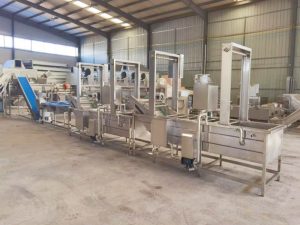
International Food Safety and Engineering Standards
- HACCP: Critical control points monitoring CCP1 for blanching temperature and CCP2 for frying oil quality ensures biological hazard prevention through validated critical limits.
- ISO 22000: Food safety management system documentation covers prerequisite programs for maintenance and calibration of PT100 temperature sensors throughout the process line.
- BRCGS Issue 9: High-care zoning requirements separate raw potato handling from cooked product zones with positive air pressure differentials and color-coded tooling systems.
- IFS Food: Foreign body detection via metal detectors and X-ray systems positioned post-packaging meets sensitivity standards of 1.5 millimeter ferrous and 2.0 millimeter non-ferrous detection.
- FDA 21 CFR 117: Current Good Manufacturing Practice compliance includes sanitary design of equipment with sloped surfaces for drainage and accessible clean-in-place spray balls.
- EU Regulation 2017/2158: Acrylamide mitigation requires blanching protocols that reduce precursor reducing sugars and asparagine content below benchmark levels for fried potato products.
Häufig gestellte Fragen
What is the typical power requirement for a Mid-Scale French Fries Factory Between 100000 And 500000 Usd?
A standard configuration requires 150 to 320 kilowatts of connected load depending on capacity tier from 500 to 1500 kilograms per hour. Refrigeration compressors account for 35 to 40 percent of total consumption while thermal oil heaters for frying require 25 to 30 percent. Three-phase 380 to 415 volt supply with 200 ampere main breaker capacity is standard for these installations in most industrial zones worldwide today and meets international electrical codes.
How does water hardness affect the blanching process in these production lines?
Calcium hardness above 200 parts per million causes precipitation of pectin-methyl esterase complexes that create gray discoloration on cut surfaces. The 1.0 percent SAPP solution chelates these ions while reverse osmosis pretreatment maintains hardness below 50 parts per million. This chemical balance prevents quality defects that would result in 15 to 20 percent product rejection by automated optical sorting systems during final inspection procedures daily without proper treatment.
What maintenance intervals are required for the continuous fryer oil system?
Oil filtration cartridges require replacement every 72 hours of operation while the entire oil charge turnover occurs every 8 to 12 hours depending on production rate. Heat exchanger tubes need monthly descaling with citric acid circulation to maintain heat transfer coefficients above 500 watts per square meter Kelvin. These intervals ensure free fatty acid levels remain below 0.5 percent and prevent acrylamide formation catalyst accumulation.