
Single Screw vs Twin Screw Fryer: Technical Engineering Analysis for French Fries Production
Twin screw fryers deliver superior product control and oil circulation uniformity compared to single screw designs, making them the preferred choice for high-capacity industrial french fries lines requiring precise dwell time management and minimal product breakage. Single screw systems maintain relevance in compact installations where mechanical simplicity and lower maintenance frequency outweigh advanced process control benefits.
- Key Signal 1: Throughput capacity ranges from 500 kg/hour (single screw) to 3000 kg/hour (twin screw) on standard 8-meter units
- Key Signal 2: Oil turnover rate achieves 8-12 cycles per hour in twin screw configurations versus 4-6 cycles in single screw systems
- Key Signal 3: Heat recovery efficiency reaches 82-88% in twin screw designs due to counter-current oil flow optimization
- Key Signal 4: Product breakage rate reduction of 35-40% observed in twin screw fryers during pilot testing
- Key Signal 5: System redundancy factor increases mechanical availability from 92% to 97% in twin screw architectures
Industrial fryer selection fundamentally impacts final product texture consistency, oil absorption rates, and overall line efficiency. Engineers must evaluate screw configuration based on product specifications, factory footprint constraints, and required automation level rather than initial equipment specifications alone.

Mechanical Design Principles and Oil Circulation Dynamics
Single screw fryers utilize a single longitudinal conveyor screw rotating at 0.5 to 2.5 RPM to transport product through the oil bath. The screw flights create discrete pockets that control dwell time but generate uneven oil flow patterns, creating temperature stratification zones exceeding 8°C vertically across the fryer cross-section. This design requires external oil circulation pumps rated at 80-120 m³/hour to maintain thermal equilibrium.
Twin screw configurations employ two intermeshing screws with opposing flight directions, typically operating at synchronized speeds of 1.0 to 3.0 RPM. The inter-screw region generates active oil pumping action, creating internal circulation rates of 150-200 m³/hour without external pumps. This self-pumping effect eliminates temperature stratification, maintaining vertical uniformity within 2°C across the full fryer depth.
Comparative Technical Specifications
| Параметр | Single Screw System | Twin Screw System | Engineering Impact |
|---|---|---|---|
| Oil Velocity Profile | Laminar flow zones near screw root | Turbulent flow throughout inter-screw gap | Heat transfer coefficient improvement 40% |
| Product Agitation | Passive movement along flights | Active tumbling between screws | Uniform coating and reduced clumping |
| Mechanical Complexity | 15-20 major components | 28-35 major components | Maintenance interval reduction from 720h to 500h |
| Drive Power Requirement | 5.5-7.5 kW per meter length | 9.0-12.0 kW per meter length | Energy increase offset by eliminated circulation pumps |
| Clean-in-Place Cycle | 4.5 hours complete sanitation | 6.0 hours complete sanitation | Additional 90 minutes for inter-screw cavity access |
The critical engineering decision point centers on product geometry and coating requirements. Twin screw systems excel with irregular-cut products and batter-coated fries due to active tumbling action that prevents sticking. Single screw systems perform adequately for uniform straight-cut fries where mechanical simplicity reduces long-term parts inventory requirements by approximately 60%.

European Frozen Fries Line Technical Implementation
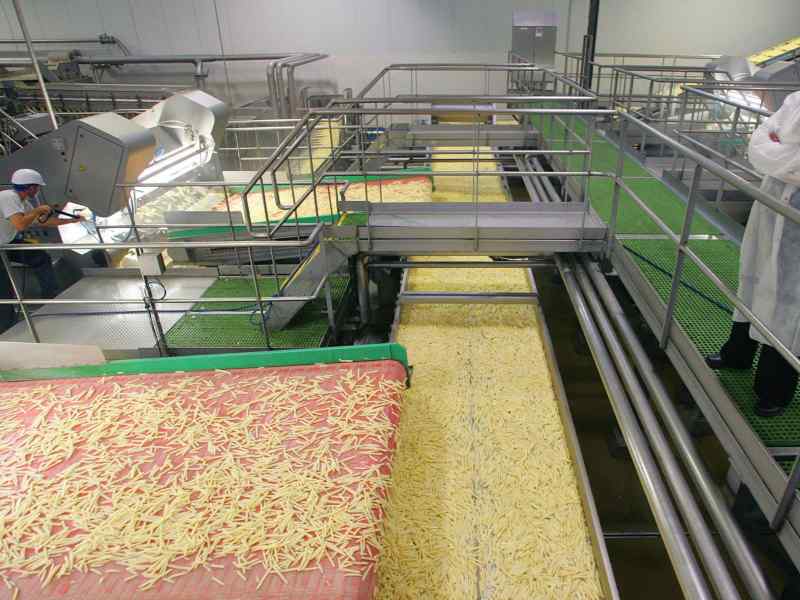
A 2024 installation in Poland processing 2500 kg/hour of 7mm straight-cut fries demonstrates twin screw fryer selection criteria. The project required ±30 seconds dwell time tolerance across all product zones to achieve target moisture content of 62-65%. Single screw pilot testing showed 12% product deviation outside specification due to oil temperature gradients. Twin screw implementation reduced deviation to 3% through active circulation and uniform heat distribution.
The engineering team specified stainless steel 316L screws with 400mm pitch and 25mm flight depth to handle product loading of 85 kg/m². Oil inlet distribution headers positioned between the screws created counter-current flow opposing product transport direction. This configuration achieved oil turnover of 10.5 cycles/hour at 165°C operating temperature with 2.5°C maximum temperature variation measured by 12 thermocouples across the 10-meter fryer length.
Commissioning data revealed mechanical availability of 96.8% over 180-day continuous operation. Maintenance events totaled 14 hours monthly, primarily for oil filtration system integration rather than screw mechanism issues. The twin screw design accommodated emergency single-screw operation during gearbox servicing, maintaining 60% production capacity versus complete line shutdown required for single screw systems.
Engineering Decision Framework
When does twin screw design become technically mandatory?
Twin screw configuration becomes engineering-critical when processing coated products, operating above 1500 kg/hour capacity, or requiring dwell time precision tighter than ±45 seconds. The active tumbling action prevents coating delamination and ensures uniform texture development across high-throughput volumes.
What are the oil quality implications of screw configuration?
Twin screw systems extend oil usable life by 15-20% due to improved circulation reducing thermal degradation hotspots. The continuous mixing action maintains uniform oil age distribution, preventing localized oxidation zones that form near heating elements in poorly circulated single screw designs.
How does screw selection affect downstream oil removal?
Product exit orientation differs significantly. Single screw systems discharge product in linear orientation requiring dedicated shaker alignment. Twin screw systems eject product in randomized orientation that naturally distributes across shaker width, improving oil drainage efficiency by 8-12% through reduced product stacking.
Can twin screw fryers operate effectively with partial loads?
Partial load operation below 40% capacity creates oil flow imbalances in twin screw systems. The self-pumping effect requires minimum product volume for proper hydraulic coupling. Single screw systems demonstrate superior performance under variable load conditions, maintaining consistent transport mechanics down to 25% capacity.
What instrumentation differences exist between configurations?
Twin screw fryers require redundant temperature monitoring at three vertical positions due to complex flow patterns. Single screw systems need only surface and bottom zone monitoring. Both configurations integrate oil level sensors, but twin screw designs add inter-screw pressure sensors to detect product jamming conditions.