
How Frozen French Fries Are Manufactured: The Complete 11-Step Process Flow Explained
Frozen french fries are manufactured through an 11-step continuous industrial process that transforms raw potatoes into IQF-frozen, par-fried strips ready for retail or foodservice. The full flow runs washing → de-stoning → peeling → inspection → cutting → blanching (75–85 °C) → dewatering → par-frying (170–185 °C, 30–60 seconds) → de-oiling → IQF freezing (−35 to −40 °C) → packaging, with a typical yield of 480–550 kg of finished frozen fries per 1,000 kg of raw potatoes, depending on potato variety, dry matter content, and cut specifications. Industrial production lines run this entire sequence continuously at capacities ranging from 150 kg/h to 3,000 kg/h, with the par-frying and IQF freezing stages being the most critical for determining final product crispness, oil content, and shelf life.
Based on 15 years of commissioning frozen french fries lines across Africa, the Middle East, and Southeast Asia, this guide walks you through every step in the order it happens on the factory floor — including the temperatures, timings, and quality control checkpoints that separate export-grade product from rejected batches.
Full Process Flow of a French Fries Production Line
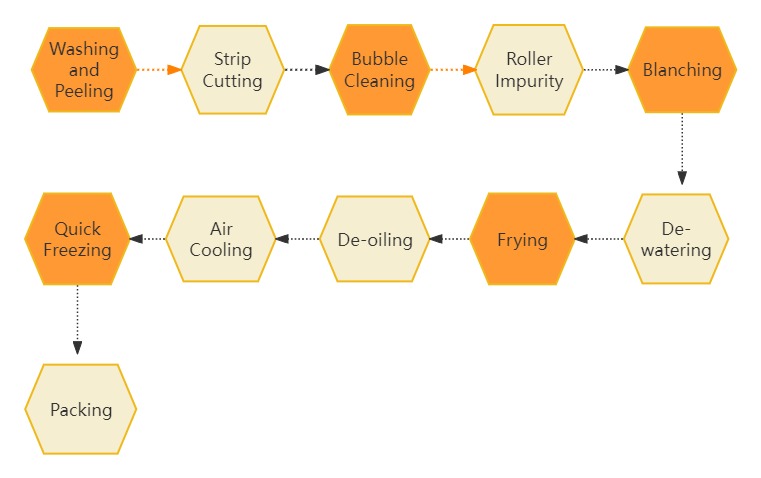
| Step | Proses | Peralatan | Key Parameters |
|---|---|---|---|
| 1 | Potato Receiving & Storage | Bulk silos | 8–12 °C, RH 90% |
| 2 | Washing & De-stoning | Drum washer + stone trap | 1–2 m³ water/ton |
| 3 | Mengupas | Abrasive or steam peeler | Loss rate 6–10% |
| 4 | Inspection & Trimming | Sorting belt | Manual + optical |
| 5 | Pemotongan | Hydraulic cutter | 8×8 / 10×10 mm |
| 6 | Memucat | Two-stage blancher | 75–85 °C, 6–10 min |
| 7 | Dewatering & Drying | Vibration + air knife | Surface moisture <3% |
| 8 | Par-Frying | Continuous fryer | 170–185 °C, 30–60 sec |
| 9 | De-Oiling | Vibration screen + air | Oil content 6–10% |
| 10 | IQF Freezing | Spiral or tunnel freezer | −35 to −40 °C, 12–18 min |
| 11 | Packaging | Multihead weigher + bagger | 1 kg / 2.5 kg / 10 kg |
Video of Frozen French Fries Manufacturing Process Step by Step

Step 1 — Potato Receiving and Pre-Storage
Fresh potatoes arrive at the factory either directly from contracted farms or from temperature-controlled long-term storage. The receiving area is equipped with bulk hoppers, weighing systems, and quality inspection stations that verify variety, size grade (typically 45–85 mm diameter), and surface defects.
Critical storage parameters:
- Temperature: 8–12 °C (too cold causes sugar accumulation → dark fries; too warm causes sprouting)
- Relative humidity: 88–92%
- Reducing sugar content: <0.3% before processing
- CIPC or maleic hydrazide treatment for sprout suppression in long storage
Field tip: From our experience commissioning lines in Egypt and Kenya, factories that skip proper pre-conditioning (warming cold-stored potatoes to 12–15 °C for 14–21 days before frying) consistently produce dark and uneven fries, regardless of how well the rest of the line is tuned.

Step 2 — Washing and De-Stoning
Potatoes enter a rotating drum washer with high-pressure water sprays to remove field soil, sand, and surface dirt. A stone trap (gravity separator) downstream removes rocks and dense foreign material that would damage downstream cutters and pumps.
- Water consumption: 1.0–2.0 m³ per ton of raw potato
- Wash drum residence time: 60–90 seconds
- Stone removal efficiency: >99% for stones >15 mm
Industrial lines increasingly use water recycling systems with sediment filtration to reduce freshwater demand by 50–70% — an important consideration for factories in water-stressed regions.

Step 3 — Peeling (Abrasive vs Steam)
Peeling is one of the most cost-sensitive steps, because peel loss directly reduces yield. Two technologies dominate:
Abrasive peeling: Rotating carborundum-coated rollers physically abrade the skin. Lower equipment cost (~$15,000–$30,000 for small lines), but higher peel loss of 8–12% and higher water use.
Steam peeling: High-pressure steam (15–18 bar) loosens skin in a pressure vessel, followed by mechanical brush removal. Equipment cost is 2–3× higher ($80,000–$200,000), but peel loss drops to 6–8% and water consumption is dramatically lower. For lines above 1,000 kg/h, steam peeling typically pays back its premium within 18–24 months through yield savings alone.mportant consideration for factories in water-stressed regions.

Step 4 — Inspection and Trimming
Peeled potatoes pass over a sorting belt where workers (or optical sorters) trim out:
- Green areas (solanine content)
- Eye sockets
- Bruises and rot
- Remaining peel patches
Modern lines integrate optical color sorters that can replace 4–6 manual inspectors and detect defects invisible to the human eye. For factories targeting export markets, optical sorting is no longer optional — it is required by most QSR buyers (McDonald’s, KFC, Burger King).

Step 5 — Cutting (Strip Geometry)
Hydraulic cutters propel pre-sized potatoes through fixed knife grids at high speed. Common strip dimensions:
| Cut Type | Dimensions | Common Use |
|---|---|---|
| Shoestring | 6×6 mm | Premium foodservice |
| Standard | 8×8 mm | Most QSR & retail |
| Steakhouse | 10×10 mm | Steakhouse-style |
| Crinkle Cut | 10×10 mm wavy | Retail differentiation |
Critical maintenance point: Cutting blades dull after 200–300 operating hours. Dull blades cause ragged surfaces, increased breakage, and uneven frying color. From the 30+ factories we have audited, 40% had blade-related quality issues — making blade replacement the single highest-ROI maintenance task.

Step 6 — Blanching (The Most Critical Quality Step)
Cut strips enter a two-stage hot-water blancher typically operated at:
- Stage 1: 75 °C for 6–8 minutes — softening and sugar leaching
- Stage 2: 85 °C for 2–4 minutes — enzyme inactivation and pre-gelatinization
Blanching serves four functions simultaneously:
- Inactivates polyphenol oxidase enzyme (prevents browning)
- Leaches reducing sugars to control finished color
- Softens texture for uniform frying
- Pre-gelatinizes starch (crispy outside, fluffy inside texture)
Some lines apply SAPP (sodium acid pyrophosphate) at 0.5–1.0% in the blanch water to prevent post-frying graying.
Skipping or under-blanching is the #1 cause of dark, uneven frozen fries. Across our commissioning history, blanching errors account for an estimated 35–45% of color-related rejections in startup operations.

Step 7 — Dewatering and Drying
After blanching, surface moisture must be reduced before frying — otherwise oil consumption skyrockets and oil splatter creates safety hazards. The dewatering line uses:
- Vibration screen: removes bulk surface water
- Air knife system: high-velocity air blasts remove residual moisture
- Optional dryer tunnel: infrared or hot-air drying for premium lines
Target surface moisture before frying: <3%. Each 1% moisture increase causes roughly 2.5–3.5% additional oil absorption during frying, directly impacting both finished oil content and production cost.

Step 8 — Par-Frying (170–185 °C, 30–60 Seconds)
Strips enter a continuous fryer (oil bath length 8–14 meters), where they are par-fried — partially cooked but not fully done. The customer or end-restaurant will finish frying later.
Standard par-frying parameters:
- Oil temperature: 170–185 °C
- Residence time: 30–60 seconds (varies by strip thickness)
- Oil type: high-oleic sunflower, palm olein, or rapeseed oil
- Oil turnover rate: 8–12 hours (critical for FFA <1.5%)
The fryer is the highest-energy and highest-CapEx unit on the entire line — a 500 kg/h continuous fryer typically costs $80,000–$200,000 and consumes 300–450 kW depending on heating type (electric vs gas vs thermal oil).
Continuous fryers outperform batch fryers on consistency, oil quality, and throughput at any capacity above 150 kg/h. Most factories we have commissioned in Pakistan and Algeria have specifically chosen continuous over batch for this reason.

Step 9 — De-Oiling and Cooling
Par-fried strips exit the fryer carrying 15–22% surface oil, which must be reduced to acceptable finished-product levels of 6–10%. Two technologies work together:
- Vibration de-oiler: mechanical agitation drips off surface oil
- Air knife or oil-removal centrifuge: premium lines achieve sub-7% oil content
Reducing finished oil content from 10% to 7% saves roughly $60–$90 per ton of finished product at current oil prices — a meaningful operating improvement that pays back de-oiling investments quickly.
After de-oiling, strips pass through a cooling tunnel to drop temperature from 90 °C to 25–30 °C before freezing. This prevents thermal shock and ice crystal damage in the IQF freezer.

Step 10 — IQF Freezing (−35 to −40 °C)
IQF stands for Individual Quick Freezing. Cooled strips enter either a spiral freezer or tunnel freezer with high-velocity cold air (−35 to −40 °C, air velocity 4–8 m/s).
Key IQF parameters:
- Air temperature: −35 to −40 °C
- Residence time: 12–18 minutes
- Product temperature exit: ≤ −18 °C
- Refrigeration load: 80–140 kW per 500 kg/h line
IQF freezing is critical because:
- Rapid freezing creates small ice crystals that don’t damage cell walls
- Slow freezing produces large crystals → soggy texture when finally cooked
- Individual freezing prevents fries from clumping together in packaging
The IQF freezer is the second highest-cost unit on the line ($120,000–$350,000 for 500 kg/h capacity) and represents 35–45% of total electricity consumption.

Step 11 — Packaging and Cold Storage
Frozen strips are conveyed to a multihead weigher + bagging machine that packs in standard formats:
- Retail: 1 kg, 2.5 kg, 5 kg PE bags
- Foodservice: 10 kg, 12.5 kg, 15 kg cartons
- Bulk export: 20 kg cartons with PE liner
Packaging speeds range from 40 bags/min for small lines to 120 bags/min for industrial lines. Metal detection and X-ray inspection are mandatory for export.
Final product is stored at −18 °C or colder until shipment. Shelf life under proper cold chain: 18–24 months.

Yield, Utility, and Economic Benchmarks
For a 500 kg/h fully-automatic frozen french fries production line, typical industry benchmarks are:
| Parameter | Benchmark |
|---|---|
| Yield (raw → finished) | 48–55% |
| Konsumsi air | 3–5 m³/ton finished |
| Electricity consumption | 320–420 kWh/ton finished |
| Konsumsi minyak | 90–130 kg/ton finished |
| Steam consumption | 0.4–0.6 ton/ton finished |
| Labor required | 10–14 workers/shift |
| Total equipment cost | $500,000–$850,000 |
Real Case: 500 kg/h Line Commissioned in Kenya (2023)
In Q2 2023, our engineering team commissioned a 500 kg/h fully-automatic frozen french fries production line for a private equity-backed startup near Nairobi, Kenya. The project parameters:
- Total equipment investment: $720,000
- Total project cost including building & cold storage: $1.25 million
- Commissioning duration: 6 weeks (4 weeks installation + 2 weeks trial production)
- Initial yield achieved: 51.3% (vs target 50%)
- Key challenge solved: Local Shangi potato variety required custom blanching profile (78 °C / 9 min vs standard 82 °C / 7 min) to control color due to higher reducing sugar content
The plant reached 85% capacity utilization within 8 months and achieved payback within the projected 26-month window, supplying frozen fries to Nairobi-based QSR chains and supermarket private labels across East Africa.
FAQ: Frozen French Fries Manufacturing
How much potato do I need to produce 1 kg of frozen french fries?
You need approximately 1.85–2.10 kg of raw potatoes per 1 kg of finished frozen french fries, depending on potato variety, dry matter content, and cutting specifications. Russet Burbank potatoes (22–24% dry matter) achieve the best yield ratio, while waxy varieties used in Africa and South Asia often yield 1.95–2.20 kg raw per 1 kg finished.
What is the difference between par-fried and fully cooked frozen french fries?
Par-fried (par-cooked) fries are partially fried for 30–60 seconds during manufacturing and require final frying at 175 °C for 2.5–3.5 minutes at the restaurant or home. Fully cooked frozen fries are fully fried during manufacturing and only need to be reheated (oven, microwave, or air fryer). Roughly 92% of global frozen french fries are par-fried, because the par-fried format delivers superior texture when finished by the end-user.
How long does it take to complete the entire frozen french fries production process from raw potato to finished frozen product?
The entire continuous process takes approximately 35–55 minutes per batch from washing to packaging, with the blanching (10 min), par-frying (1 min), and IQF freezing (15 min) being the longest residence-time stages. A continuous industrial line operates 24/7 in steady state, so output is governed by the line’s hourly capacity rating, not the per-batch time.
Need help planning your own frozen french fries production line? With 15 years of field commissioning experience across 30+ countries in Africa, Southeast Asia, the Middle East, and Latin America, our engineering team can deliver turnkey lines from 150kg/jam to 3,000 kg/h capacity.
Read More: Biaya Pabrik Kentang Goreng, Kapasitas Lini Produksi Kentang Goreng Beku


